
Introduction
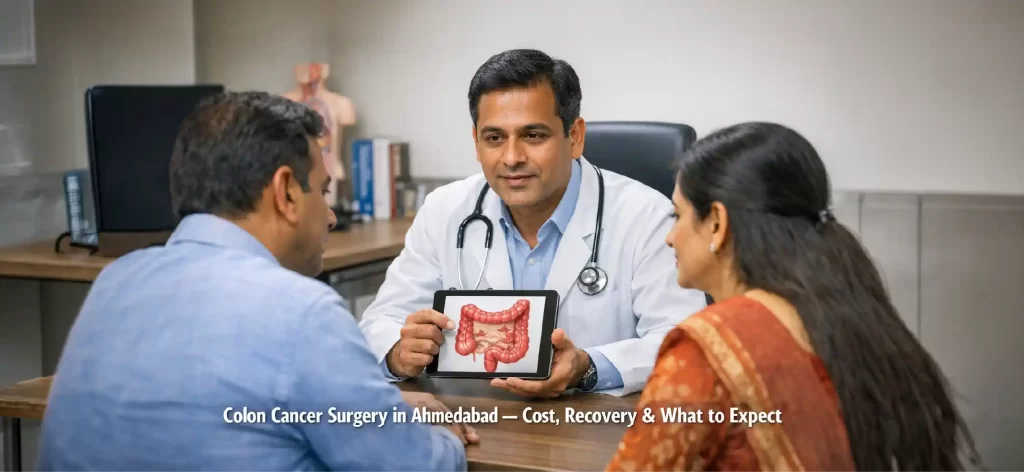
When a diagnosis of colon cancer is confirmed, the first question most patients and families ask is: What happens next? For many, surgery is a central part of the treatment journey — and finding the right surgical team makes all the difference. Colon cancer surgery in Ahmedabad has advanced significantly in recent years, and patients across Gujarat now have access to internationally benchmarked colorectal surgical care without travelling to another city.
At Zanish Cancer Hospital, we understand that a colon cancer diagnosis brings fear, uncertainty, and an urgent need for answers. This article is written to help you — the patient or caregiver — understand what colon cancer surgery involves, what to expect before, during, and after the procedure, what it may cost, and how our team approaches your care with both precision and compassion.
Whether you have just been diagnosed, are exploring treatment options, or are seeking a second opinion, this guide is for you.
Understanding Colon Cancer
The colon, or large intestine, is the final section of the digestive tract. Colon cancer — also called colorectal cancer when it includes the rectum — typically begins as small, benign clumps of cells called polyps that over time can become cancerous.
It is one of the most commonly diagnosed cancers in India, and when caught early, it is also one of the most treatable. This is why awareness, early screening, and prompt action are so important.
Common Symptoms of Colon Cancer
Colon cancer may not cause noticeable symptoms in its early stages. When symptoms do appear, they may include:
- A persistent change in bowel habits (diarrhoea, constipation, or narrowing of stool)
- Blood in the stool or rectal bleeding
- Persistent abdominal discomfort — cramping, gas, or pain
- A feeling that the bowel doesn’t empty completely
- Unexplained weight loss
- Fatigue or weakness without a clear cause
If you notice any of these symptoms lasting more than two to three weeks, please consult an oncologist promptly. Early-stage colon cancer is far more amenable to curative surgery.
Risk Factors
Understanding your risk helps in timely screening. Common risk factors include:
- Age above 50
- Personal or family history of colorectal cancer or polyps
- Inflammatory bowel disease (Crohn’s disease or ulcerative colitis)
- A low-fibre, high-fat diet
- Sedentary lifestyle and obesity
- Smoking and heavy alcohol use
- Genetic conditions such as Lynch syndrome or FAP (Familial Adenomatous Polyposis)
How Is Colon Cancer Diagnosed?
Before surgery can be planned, a thorough diagnostic evaluation is essential. At Zanish Cancer Hospital, diagnosis typically involves:
- Colonoscopy with Biopsy: The gold standard — a flexible camera examines the full length of the colon, and tissue samples are taken from any suspicious areas.
- CT Colonography (Virtual Colonoscopy): A non-invasive imaging alternative for select patients.
- CT Scan of Abdomen and Pelvis: To assess the extent of the tumour and check for spread to nearby lymph nodes or organs.
- PET-CT Scan: For staging and identifying distant metastases.
- CEA Blood Test: Carcinoembryonic antigen, a tumour marker used to monitor treatment response.
- MRI Pelvis: Particularly important for rectal cancer to guide surgical planning.
Accurate staging — from Stage I (localised) to Stage IV (spread to distant organs) — is the foundation of every treatment decision.
Colon Cancer Surgery: Types and Approaches
Surgery is the primary treatment for most stages of colon cancer. The goal is to remove the tumour along with a margin of healthy tissue and the associated lymph nodes — a procedure called a colectomy.
Types of Colon Surgery
Partial (Segmental) Colectomy The most common procedure — the segment of colon containing the tumour is removed, along with nearby lymph nodes, and the healthy ends are reconnected (anastomosis).
Right or Left Hemicolectomy Removal of the right or left half of the colon, depending on tumour location.
Sigmoid Colectomy Removal of the sigmoid colon, the S-shaped section near the rectum — commonly performed for lower colon tumours.
Anterior Resection (for Rectal Cancer) Removal of the upper rectum with reconnection of the colon — often used for upper and middle rectal cancers.
Abdominoperineal Resection (APR) Removal of the rectum and anus for lower rectal tumours, which requires a permanent colostomy. This is only performed when the tumour location makes sphincter-preservation impossible.
Laparoscopic (Minimally Invasive) Colon Surgery
Laparoscopic colon surgery — commonly called keyhole surgery — is now the preferred approach for many patients at Zanish Cancer Hospital. Instead of a large open incision, the surgeon makes several small cuts and uses a camera and specialised instruments to perform the operation.
Advantages of Laparoscopic Colon Surgery include:
- Significantly smaller incisions and reduced scarring
- Less post-operative pain
- Shorter hospital stay (typically 3–5 days vs. 7–10 for open surgery)
- Faster return to normal activities
- Lower risk of wound complications and infection
- Equivalent oncological outcomes to open surgery in appropriate cases
Not every patient is a candidate for laparoscopic surgery — tumour size, location, previous abdominal surgery, and overall health are all considered before recommending an approach.
What to Expect: Before, During & After Surgery
Before Surgery
Your surgical team will conduct pre-operative assessments including blood tests, cardiac evaluation, anaesthesia review, and bowel preparation. A nutritional assessment may also be arranged. You will be clearly informed about the procedure, risks, and expected outcomes.
During Surgery
Depending on the approach, colon cancer surgery typically takes 2–4 hours under general anaesthesia. Lymph nodes are removed alongside the tumour specimen and sent for histopathological examination — the results guide decisions about post-operative chemotherapy.
After Surgery and Recovery
Recovery varies by patient and surgical approach, but here is a general timeline:
- Day 1–2: You will be encouraged to sit up and begin light movement; fluids are introduced gradually.
- Day 3–5: Soft diet begins; most laparoscopic patients are ready for discharge within this window.
- Week 2–4: Gradual return to light activities at home; follow-up wound care and blood tests.
- Week 6–8: Most patients return to normal daily activities; strenuous exercise is avoided for 6–8 weeks post open surgery.
- Ongoing: Regular follow-up appointments, CEA monitoring, and surveillance colonoscopies are scheduled.
A small number of patients may require a temporary or permanent stoma (colostomy or ileostomy) — an opening in the abdomen through which waste exits into a bag. Your surgical team will counsel you thoroughly on stoma care if this applies to your case.
Colon Cancer Surgery Cost in Ahmedabad
Colon cancer surgery cost in Ahmedabad depends on several factors, including the type and extent of surgery, whether it is performed laparoscopically or open, the duration of hospital stay, and any additional treatments required such as chemotherapy.
At Zanish Cancer Hospital, we are committed to cost transparency. Patients and families are provided with a clear, itemised breakdown of expected costs before treatment begins. Compared to tertiary cancer centres in Mumbai or Delhi, Ahmedabad offers significantly more affordable care — without any compromise in surgical quality or oncology expertise.
The hospital also works with most major health insurance providers and can guide patients through claims and pre-authorisation processes.
Zanish Cancer Hospital's Role in Colon Cancer Care
Zanish Cancer Hospital, founded by Dr. Nishant Sanghavi — M.Ch (Surgical Oncology, GCRI Ahmedabad) and Fellowship in Advanced Laparoscopic Surgical Oncology — is among Gujarat’s most experienced centres for colorectal cancer surgery.
What patients can expect at Zanish:
- Expert Colorectal Surgical Oncology: Dr. Sanghavi’s specialised training in GI and colorectal cancers means patients receive surgical care aligned with international oncology standards.
- Laparoscopic-First Approach: Minimally invasive techniques are offered wherever oncologically appropriate, prioritising faster recovery and better quality of life.
- Multidisciplinary Tumour Board: Every case is reviewed by surgical, medical, and radiation oncologists together — ensuring no treatment decision is made in isolation.
- Comprehensive Post-Operative Support: From stoma nursing care to nutritional counselling and psychological support, the patient journey is supported end to end.
- Convenient Ahmedabad Location: Situated in Naranpura, the hospital is easily accessible for patients from across Gujarat, Rajasthan, and central India.
- 24/7 Helpline: Patients and families have round-the-clock access to support from the care team.
Conclusion: You Don't Have to Face This Alone
Colon cancer surgery is a significant step — but it is also often the most important step toward recovery. With the right surgical team, the right preparation, and the right support, many patients go on to live full, healthy lives after treatment.
If you or a loved one has been diagnosed with colon cancer, or if you are experiencing symptoms that concern you, do not delay seeking expert evaluation. Early action saves lives.
Disclaimer: This article is for informational purposes only and does not substitute professional medical advice. Please consult a qualified surgical oncologist for a diagnosis and treatment plan tailored to your individual condition.
Make Appointment
Address
1st Floor, Viva Atelier, Opp. B.D. Patel House, Near Sardar Patel Statue, Behind Sardar Patel Colony, Naranpura, Ahmedabad-380014. (Gujarat) India
Contact Us
+91 7433852300