
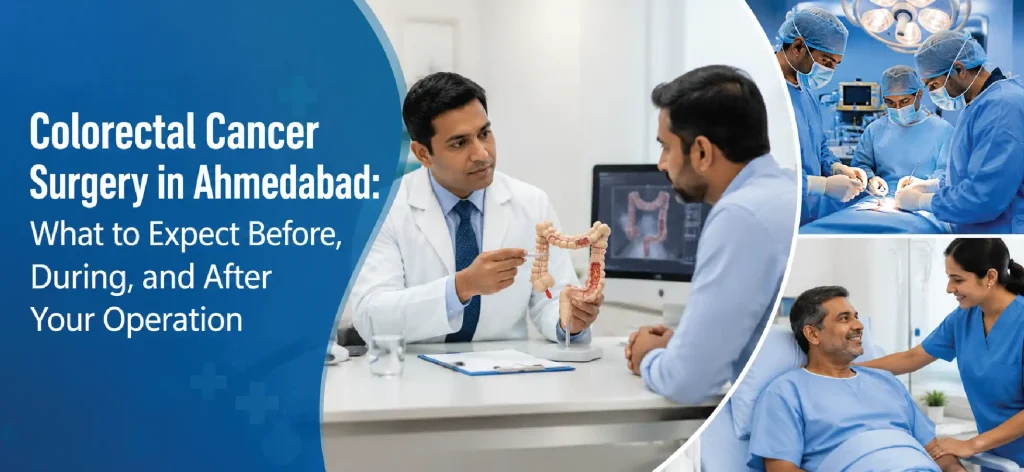
Facing Surgery Can Feel Overwhelming — But Knowing What to Expect Makes a Real Difference
A diagnosis of colorectal cancer — whether it affects the colon or the rectum — brings with it a great deal of uncertainty. For most patients, surgery forms the cornerstone of treatment, and the prospect of a major abdominal operation understandably raises many questions and concerns. If you or a family member is preparing for colorectal cancer treatment in Ahmedabad, one of the most helpful things you can do is understand what the surgical journey actually involves — from the first consultation through to recovery at home.
Fear of the unknown is often more distressing than the reality of a well-managed surgical experience. This article is designed to walk you through each stage of colorectal cancer surgery in plain, honest language — what happens before your operation, what takes place in the operating theatre, and what the recovery process looks like in the weeks that follow.
At Zanish Cancer Hospital in Ahmedabad, we believe that an informed patient is a more confident and better-prepared patient. Our gastrointestinal oncology team is here to guide you at every step.
Understanding Colorectal Cancer and Why Surgery Is Usually Recommended
Colorectal cancer refers to cancers that develop in the colon (large intestine) or the rectum (the final section of the large intestine before the anus). It is one of the most commonly diagnosed cancers in India and, when detected at an early or intermediate stage, is highly treatable with surgical intervention.
Surgery aims to remove the cancerous portion of the bowel along with a margin of healthy tissue and the associated lymph nodes — a procedure that both treats the cancer and provides critical information about staging and the need for further treatment.
The specific type of surgery recommended depends on several factors:
- The location of the tumour within the colon or rectum
- The stage of the cancer at diagnosis
- Whether the cancer has spread to adjacent structures or lymph nodes
- The patient’s overall health and fitness for surgery
Whether minimally invasive surgery is technically feasible
Before Your Operation: Preparation and What to Expect
Initial assessment and staging
Before any surgical decision is finalised, a thorough assessment is carried out. This typically includes colonoscopy with biopsy to confirm the diagnosis, CT scanning of the chest, abdomen, and pelvis to assess the extent of disease, and in rectal cancer cases, an MRI of the pelvis to evaluate the tumour’s relationship to surrounding structures. Blood tests, carcinoembryonic antigen (CEA) measurement, and in some cases PET-CT scanning complete the staging picture.
All of this information is reviewed at Zanish Cancer Hospital’s multidisciplinary tumour board, where surgical oncologists, medical oncologists, radiation oncologists, radiologists, and pathologists collectively determine the most appropriate treatment plan for your specific case.
Neoadjuvant treatment before surgery
For patients with rectal cancer — particularly those with locally advanced disease — treatment before surgery (known as neoadjuvant therapy) may be recommended. This typically involves a course of radiation therapy combined with chemotherapy, aimed at shrinking the tumour before surgical resection. Neoadjuvant treatment can improve the chances of complete surgical removal and, in some cases, may allow for a less extensive operation.
Not all colorectal cancer patients require pre-operative treatment — colon cancer is usually treated with surgery first, followed by chemotherapy if indicated.
Bowel preparation
In most cases, patients are asked to follow a specific bowel preparation regimen in the days before surgery. This may involve dietary restrictions, laxative preparations, and in some cases antibiotic bowel preparation. Your surgical team will provide detailed written instructions tailored to your specific procedure.
Pre-operative assessment clinic
Before your admission date, you will attend a pre-operative assessment clinic where your fitness for surgery and anaesthesia is evaluated. This includes a review of your medical history, current medications, blood tests, ECG, and in some cases further investigations such as lung function tests or cardiac assessment. Any medications that need to be paused before surgery — including blood thinners — will be identified at this point.
What to bring and what to arrange
For your hospital admission, bring all investigation reports, your medication list, and any personal items you will need during your stay. It is also important to arrange post-discharge support before your operation — particularly for the first one to two weeks at home, when you will need assistance with daily activities.
During Your Operation: What Actually Happens
Types of colorectal cancer surgery
Right hemicolectomy — removal of the right side of the colon, used for cancers of the caecum and ascending colon.
Left hemicolectomy — removal of the left side of the colon, used for cancers of the descending colon.
Sigmoid colectomy — removal of the sigmoid colon, used for sigmoid colon cancers.
Anterior resection — removal of the upper rectum and part of the sigmoid colon, used for upper and mid-rectal cancers. This procedure preserves bowel continuity in most cases.
Low anterior resection — a more extensive rectal resection used for lower rectal cancers, requiring careful surgical technique to preserve sphincter function where oncologically safe.
Abdominoperineal resection (APR) — removal of the rectum and anus, required for very low rectal cancers where sphincter preservation is not possible. This procedure results in a permanent colostomy.
Open versus minimally invasive surgery
Colorectal cancer surgery can be performed as open surgery (through a larger abdominal incision) or using minimally invasive techniques — laparoscopic (keyhole) surgery or robotic-assisted surgery. Minimally invasive approaches are associated with reduced post-operative pain, shorter hospital stays, faster return to normal activities, and lower rates of certain complications in eligible patients.
At Zanish Cancer Hospital, we offer laparoscopic and robotic-assisted colorectal cancer surgery for appropriate candidates. The decision between open and minimally invasive surgery is made based on tumour characteristics, prior surgical history, body habitus, and the surgeon’s assessment of what will achieve the safest and most complete resection.
Stoma formation — temporary or permanent
Some patients undergoing colorectal cancer surgery will require a stoma — an opening on the abdominal wall through which the bowel can empty into a pouch. A stoma may be:
- Temporary — created to allow a bowel join (anastomosis) to heal safely, and reversed in a second procedure typically 3–6 months later
- Permanent — required when the anus and sphincter muscles cannot be preserved, as in abdominoperineal resection
If a stoma is part of your planned operation, your surgical team will discuss this with you well in advance, and a specialist stoma care nurse will meet with you before surgery to provide education and emotional support.
After Your Operation: Recovery in Hospital and at Home
The first days in hospital
Most patients undergoing colorectal cancer surgery spend between 3 and 7 days in hospital, though this varies by procedure and individual recovery. Enhanced Recovery After Surgery (ERAS) protocols — which are standard practice at Zanish Cancer Hospital — are designed to reduce complications, shorten hospital stays, and support faster recovery. These protocols include early mobilisation (getting out of bed the day after surgery), early reintroduction of oral fluids and nutrition, effective pain management, and minimising intravenous fluids once oral intake is established.
Pain is managed proactively using a combination of approaches including epidural or spinal analgesia, oral medications, and local anaesthetic techniques — reducing the need for strong opioid medications and their associated side effects.
Returning home: the first two to four weeks
The first weeks at home are a period of gradual recovery. Most patients experience:
- Fatigue, which is normal and gradually improves over several weeks
- Changes in bowel habit — frequency, urgency, or altered stool consistency — which typically settle over weeks to months as the bowel adapts
- Wound tenderness and mild discomfort around the incision sites
- Dietary adjustments as the bowel recovers — your team will provide specific guidance
Light walking is encouraged from the earliest days of recovery. Driving is usually restricted for several weeks, depending on recovery and surgeon advice. Lifting and strenuous activity should be avoided for 6–8 weeks or as directed by your surgeon.
Follow-up and adjuvant treatment
At your post-operative follow-up appointment, the final pathology report from your resected specimen will be discussed. This report confirms the completeness of surgical resection and provides detailed staging information. Based on these results, your multidisciplinary team will determine whether adjuvant chemotherapy is recommended to reduce the risk of cancer recurrence.
Long-term surveillance — including regular CEA blood tests and colonoscopic follow-up — forms part of your ongoing care plan following treatment completion.
How Zanish Cancer Hospital Approaches Colorectal Cancer Surgery in Ahmedabad
At Zanish Cancer Hospital, our gastrointestinal oncology programme is built around the principle that the best outcomes in colorectal cancer surgery come from specialist expertise, careful planning, and continuity of care.
Patients from across Gujarat — including Surat, Vadodara, Rajkot, Gandhinagar, and surrounding regions — travel to Ahmedabad for colorectal cancer surgery at our centre. We work to make this process as smooth as possible, coordinating investigations, consultations, and admissions efficiently.
Our colorectal cancer services include:
- Multidisciplinary tumour board review for every new colorectal cancer case
- Laparoscopic and robotic-assisted colectomy and rectal resection
- Open colorectal surgery for complex or locally advanced cases
- Neoadjuvant chemoradiation for rectal cancer
- Specialist stoma care nursing and patient education
- Enhanced Recovery After Surgery (ERAS) protocols
- Adjuvant chemotherapy planning and coordination
- Long-term oncological follow-up and surveillance colonoscopy
- Psychological support and dietary counselling during and after treatment
Frequently Asked Questions
The surgeon removes the cancerous section of colon or rectum along with a margin of healthy bowel and the associated lymph nodes. The remaining bowel ends are then rejoined or, where this is not possible, a stoma is formed. Surgery may be performed as open or minimally invasive (laparoscopic or robotic) depending on the case.
Most patients spend 3–7 days in hospital and return to light activities within 2–4 weeks at home. Bowel habit changes are common in the early weeks and typically improve with time. Full recovery varies by procedure but most patients are back to normal activities within 6–8 weeks.
The best specialist for your case is a dedicated surgical oncologist experienced in rectal cancer surgery, working within a multidisciplinary team. At Zanish Cancer Hospital in Ahmedabad, our GI oncology team provides specialist colorectal cancer surgery with structured multidisciplinary case review for every patient.
You Do Not Have to Face This Alone
Colorectal cancer surgery is a significant procedure — but it is also one where preparation, expertise, and the right support system make a profound difference to the experience and the outcome. Understanding what to expect at each stage of your surgical journey allows you to approach it with greater confidence and less fear.
At Zanish Cancer Hospital in Ahmedabad, we are committed to walking alongside you at every step — from your first consultation through surgery, recovery, and long-term follow-up.
📍 Zanish Cancer Hospital | Ahmedabad, Gujarat 📞 Book Your Consultation Today — Expert colorectal cancer care, honest guidance, and a team dedicated to your recovery and wellbeing.
Medical Disclaimer: This article is for informational purposes only and does not constitute personalised medical advice. Colorectal cancer treatment plans vary significantly between individuals based on diagnosis, staging, and overall health. Please consult a qualified surgical oncologist for a thorough assessment and individualised treatment plan. Zanish Cancer Hospital does not guarantee specific surgical or oncological outcomes.
Make Appointment
Address
1st Floor, Viva Atelier, Opp. B.D. Patel House, Near Sardar Patel Statue, Behind Sardar Patel Colony, Naranpura, Ahmedabad-380014. (Gujarat) India
Contact Us
+91 7433852300