
Introduction
When cancer appears in a family — especially across multiple generations or in younger members — it raises a question that many people are afraid to ask: could this happen to me too? Genetic cancer counseling in Ahmedabad is helping families across Gujarat find answers to that question before cancer develops, giving them the opportunity to act early rather than react late.
Hereditary cancers account for roughly 5 to 10 percent of all cancer diagnoses. While that percentage may seem small, the impact on individual families is enormous. Mutations in specific genes can dramatically elevate a person’s lifetime risk of developing certain cancers — and those mutations can be passed from parent to child. Understanding your genetic risk is not about fear. It is about knowledge, and knowledge creates choices.
At Zanish Cancer Hospital, we offer structured genetic counseling and family screening programs designed to identify hereditary cancer risk, guide testing decisions, and support patients and families through every step of what can be a deeply personal process.
What Is Genetic Counseling for Cancer?
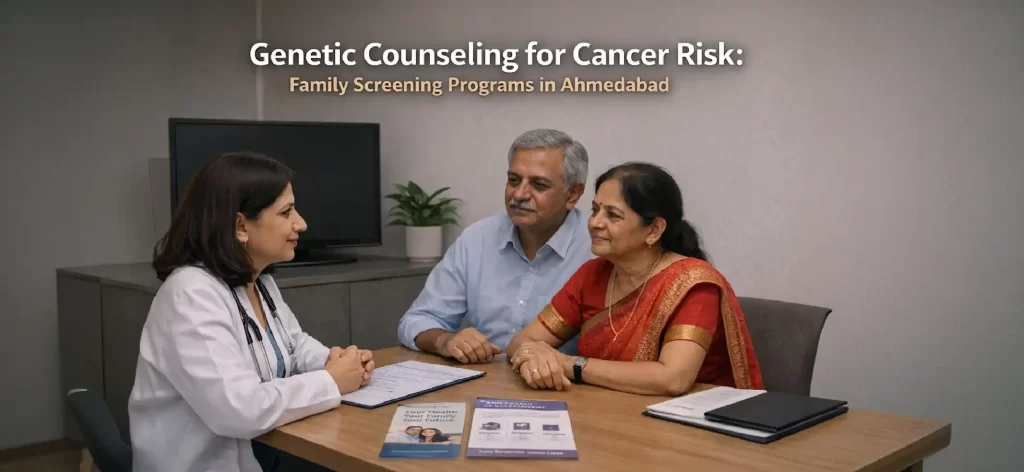
Genetic counseling for cancer is a specialized service that helps individuals and families understand whether their cancer risk has a hereditary basis. It involves a detailed review of personal and family medical history, an assessment of which genetic mutations may be relevant, guidance on whether genetic testing is appropriate, and support in interpreting and acting on test results.
A genetic counselor or oncologist with expertise in hereditary cancer works closely with the patient to build a family cancer history — often called a pedigree — that maps the occurrence of cancer across at least three generations. Patterns such as multiple family members with the same cancer, cancers appearing at unusually young ages, or rare cancers in unexpected family members may indicate a hereditary syndrome.
Which Genes and Syndromes Are Most Commonly Involved?
Several well-documented genetic mutations significantly increase cancer risk. The most widely known include:
- BRCA1 and BRCA2 mutations, which increase the risk of breast, ovarian, pancreatic, and prostate cancers
- Lynch syndrome (caused by mutations in MLH1, MSH2, MSH6, or PMS2 genes), which is associated with colorectal, endometrial, ovarian, and other cancers
- TP53 mutations linked to Li-Fraumeni syndrome, which raises risk across multiple cancer types including sarcomas, brain tumors, and leukemias
- APC gene mutations associated with familial adenomatous polyposis, a condition that strongly predisposes individuals to colorectal cancer
- PALB2, CHEK2, and ATM gene mutations, which are increasingly recognized as moderately increasing breast and other cancer risks
It is important to note that carrying one of these mutations does not mean cancer will definitely develop. It means the risk is elevated and that proactive monitoring or preventive measures may be warranted.
Who Should Consider Genetic Counseling?
Genetic counseling is not necessary for everyone, but it is worth considering if any of the following apply to you or your family:
- Two or more close relatives on the same side of the family diagnosed with the same or related cancers
- A family member diagnosed with cancer before the age of 50
- A personal or family history of ovarian cancer, which has a strong hereditary component
- Male breast cancer in the family
- A known BRCA or other hereditary cancer mutation identified in a family member
- Multiple primary cancers in one individual — for example, someone who has had both breast and ovarian cancer
- A family history of rare cancers such as retinoblastoma, adrenal gland tumors, or multiple endocrine neoplasia
- Ashkenazi Jewish ancestry, which carries a higher prevalence of BRCA1 and BRCA2 mutations
If you are unsure whether your family history meets the threshold for concern, a brief consultation with a specialist can help clarify whether a full genetic counseling session is recommended.
What Does the Genetic Testing Process Involve?
Genetic testing for hereditary cancer risk is typically a straightforward process. It begins with a blood or saliva sample, which is sent to a specialized laboratory for analysis. Depending on the family history and clinical picture, testing may target a single gene, a panel of several genes, or in some cases, broader genomic sequencing.
Results generally fall into three categories:
- Positive: A known pathogenic mutation has been identified, confirming elevated hereditary risk
- Negative: No mutation was found in the genes tested — though this does not completely eliminate risk, it is generally reassuring
- Variant of uncertain significance (VUS): A genetic change was detected, but its impact on cancer risk is not yet fully understood
Interpreting these results requires clinical context and expert guidance. A positive result, for example, does not automatically mean aggressive intervention is required. The appropriate response depends on the specific mutation, the cancers it is associated with, and the individual’s age, personal health, and preferences.
What Happens After a Positive Result?
A confirmed hereditary cancer mutation opens the door to a range of proactive options. These may include:
- Enhanced surveillance: More frequent screenings such as annual MRI alongside mammography for BRCA mutation carriers, or colonoscopies starting at a younger age for Lynch syndrome
- Risk-reducing medications: Chemoprevention agents such as tamoxifen or raloxifene may be appropriate for some high-risk individuals
- Preventive surgery: In carefully selected cases, risk-reducing procedures such as prophylactic mastectomy or salpingo-oophorectomy may be discussed — though these decisions are highly individual and must be made with full information and emotional support
- Cascade testing: Once a mutation is identified in one family member, other at-risk relatives can be offered targeted testing for that specific mutation
The goal is never to alarm patients but to empower them with options they would not otherwise have access to.
Genetic Counseling in the Gujarat Context
Awareness of hereditary cancer risk remains relatively limited across Gujarat compared to urban metros like Mumbai or Delhi. Many families in Ahmedabad and surrounding areas have experienced cancer across generations without ever connecting those diagnoses to a possible genetic pattern. Cultural factors — including reluctance to discuss cancer within families or concerns about stigma — can also delay the recognition of hereditary risk.
At Zanish Cancer Hospital, we approach genetic counseling with sensitivity to these realities. Our team communicates in a way that is accessible, respectful, and free from unnecessary alarm. We understand that for many families in Gujarat, this may be an entirely new concept — and we take the time to explain it clearly and compassionately.
Zanish Cancer Hospital's Role in Hereditary Cancer Screening
Zanish Cancer Hospital offers a structured, oncologist-guided approach to genetic cancer counseling and family screening in Ahmedabad. Our services include:
- Detailed personal and family cancer history review and pedigree construction
- Clinical risk assessment to determine whether genetic testing is appropriate
- Coordination with accredited genetic testing laboratories for BRCA, Lynch syndrome, and multi-gene panel testing
- Clear, jargon-free explanation of test results and their implications
- Individualized surveillance and risk management plans for mutation carriers
- Support for cascade family screening when a mutation is identified
- Coordination with our surgical oncology team for preventive intervention discussions when clinically appropriate
Our team is led by Dr. Nishant Sangvi, whose training at GCRI Ahmedabad and Galaxy Care Institute Pune has equipped him with a comprehensive understanding of hereditary cancer syndromes and their surgical implications. We work collaboratively with medical oncology and, where needed, hematology specialists through our partnership with Marengo CIMS Hospital.
We are accessible to patients from across Gujarat, with our hospital located in Naranpura, Ahmedabad — a well-connected area within the city and reachable from major towns across the state.
Conclusion: Knowledge Is the First Step Toward Prevention
Hereditary cancer risk is not a verdict — it is information. And with the right information, families can take meaningful steps to reduce their risk, catch cancer earlier, and make decisions from a position of understanding rather than uncertainty.
If you have a strong family history of cancer or simply want to understand your hereditary risk, genetic counseling at Zanish Cancer Hospital can give you clarity and a clear path forward.
Disclaimer: This article is intended for informational purposes only and does not constitute medical advice. Genetic testing and counseling decisions should always be made in consultation with a qualified healthcare professional.
Make Appointment
Address
1st Floor, Viva Atelier, Opp. B.D. Patel House, Near Sardar Patel Statue, Behind Sardar Patel Colony, Naranpura, Ahmedabad-380014. (Gujarat) India
Contact Us
+91 7433852300