
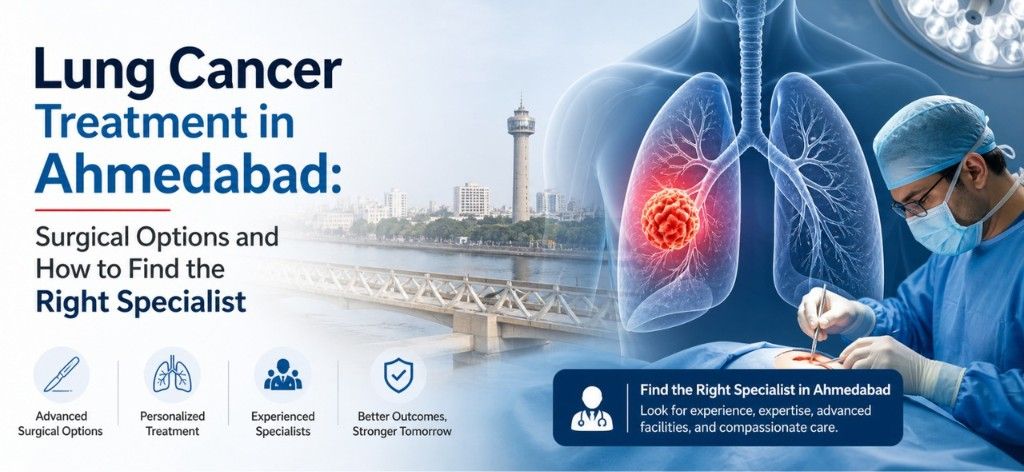
Introduction
A lung cancer diagnosis can feel like the ground has shifted beneath your feet. Whether it is you or someone you love facing this news, the immediate questions are often the same: What are my treatment options? Where do I find the right specialist? Which hospital in Ahmedabad can genuinely help?
Accessing quality lung cancer treatment in Ahmedabad has become significantly more achievable in recent years, with specialised oncology centres offering advanced diagnostic and surgical capabilities locally. Patients across Gujarat and neighbouring states no longer need to travel to distant cities seeking expert care.
This article is written for patients and families who want clear, honest information about lung cancer — its symptoms, how it is diagnosed, what surgical and non-surgical treatment options exist, and what to look for when choosing a lung cancer specialist in Ahmedabad. Our aim is to help you feel informed and empowered as you navigate your care journey.
Understanding Lung Cancer: A Brief Overview
Lung cancer occurs when abnormal cells in the lung tissue grow uncontrollably, forming a tumour that can interfere with normal lung function. It is one of the most commonly diagnosed cancers globally and remains a leading cause of cancer-related mortality in India.
There are two primary types:
- Non-Small Cell Lung Cancer (NSCLC) — accounts for approximately 85% of all lung cancer cases. Subtypes include adenocarcinoma, squamous cell carcinoma, and large cell carcinoma.
- Small Cell Lung Cancer (SCLC) — less common but tends to grow and spread more rapidly. It is strongly associated with smoking.
Understanding which type and stage of lung cancer a patient has is essential, as this directly determines the most appropriate treatment approach.
Recognising the Symptoms: When to Seek Medical Attention
Lung cancer is often called a “silent disease” because early-stage symptoms can be mild or easily attributed to other causes. Awareness of warning signs is critical for early detection.
Common symptoms include:
- A persistent cough that does not resolve after 2–3 weeks
- Coughing up blood or blood-tinged sputum
- Unexplained shortness of breath or breathlessness during routine activities
- Chest pain that worsens with deep breathing, coughing, or laughing
- Hoarseness or significant change in voice
- Unexplained weight loss and loss of appetite
- Recurrent chest infections such as pneumonia or bronchitis
- Persistent fatigue
If you or a family member in Ahmedabad or surrounding areas is experiencing any of these symptoms — particularly if you are a current or former smoker — it is important to consult a lung cancer specialist promptly. Early diagnosis significantly improves treatment outcomes.
Risk Factors for Lung Cancer
While smoking remains the most significant risk factor — responsible for the majority of lung cancer cases — it is not the only one. Non-smokers can and do develop lung cancer.
Key risk factors include:
- Smoking — including passive (secondhand) smoke exposure
- Occupational exposure — to asbestos, radon gas, arsenic, chromium, or diesel exhaust
- Air pollution — prolonged exposure to high levels of outdoor or indoor air pollution
- Family history — a first-degree relative with lung cancer increases personal risk
- Previous lung conditions — such as COPD or pulmonary fibrosis
- Prior radiation therapy to the chest area
Being aware of these risk factors is not a cause for panic — it is an invitation to be proactive about your health and screening.
Diagnosing Lung Cancer: What to Expect
Accurate diagnosis and staging are the foundation of effective lung cancer treatment. The diagnostic process typically involves:
- Chest X-ray and CT scan — to detect and evaluate suspicious lung masses
- PET scan — to assess whether cancer has spread to lymph nodes or other organs
- Bronchoscopy — a thin flexible scope passed into the airways to examine and biopsy suspicious areas
- CT-guided biopsy — for tumours not easily accessible by bronchoscopy
- Pulmonary function tests — to assess lung capacity before surgical planning
- Molecular and genetic testing — to identify specific mutations (EGFR, ALK, ROS1, PD-L1) that guide targeted therapy decisions
Staging lung cancer — from Stage I (localised) to Stage IV (spread to distant organs) — is essential before any treatment decision is made.
Lung Cancer Treatment Options: A Comprehensive Overview
Treatment for lung cancer is not one-size-fits-all. The most effective approach depends on the cancer type, stage, location, and the patient’s overall health and lung function.
Surgical Treatment for Lung Cancer
Surgery is the primary treatment for early-stage, localised non-small cell lung cancer when the patient is fit enough to undergo an operation. The goal of surgery is complete removal of the tumour with clear margins.
Common surgical procedures for lung tumour surgery in Gujarat include:
- Lobectomy — removal of the affected lobe of the lung; the most common and preferred surgical approach for early-stage NSCLC
- Segmentectomy or Wedge Resection — removal of a smaller portion of the lung; suitable for patients with limited lung reserve or smaller tumours
- Pneumonectomy — removal of an entire lung; reserved for cases where the tumour is centrally located or involves the main bronchus
Minimally invasive approaches, including Video-Assisted Thoracoscopic Surgery (VATS) and robotic-assisted thoracic surgery, are increasingly used for lung cancer procedures. These techniques use small incisions, offer faster recovery, and result in less post-operative pain compared to traditional open chest surgery — while maintaining equivalent oncological outcomes in appropriately selected patients.
Non-Surgical Treatment Options
For patients with advanced-stage disease, or those who are not surgical candidates due to health reasons, several effective treatment options exist:
- Chemotherapy — uses anti-cancer drugs to kill or slow the growth of cancer cells; often used in combination with other treatments
- Radiation therapy — high-energy X-rays or other radiation sources targeted at the tumour; used as primary treatment, adjuvant therapy, or palliative care
- Targeted therapy — drugs designed to attack specific genetic mutations in cancer cells (e.g., EGFR inhibitors, ALK inhibitors); applicable when molecular testing identifies a targetable mutation
- Immunotherapy — activates the body’s own immune system to recognise and attack cancer cells; checkpoint inhibitors such as pembrolizumab are now standard of care in certain lung cancer profiles
- Stereotactic Body Radiotherapy (SBRT) — a highly precise form of radiation therapy effective for early-stage lung cancer in patients who cannot undergo surgery
In many cases, a multimodal approach — combining surgery, chemotherapy, radiation, and/or targeted therapy — delivers the best outcomes. This is why multidisciplinary care is essential.
How to Find the Right Lung Cancer Specialist in Ahmedabad
Choosing the right specialist is one of the most important decisions a lung cancer patient and family will make. Here is what to look for:
- Specialisation in thoracic or surgical oncology — a surgeon specifically trained in lung and chest cancer procedures
- Multidisciplinary team support — the specialist should work within a team that includes medical oncologists, radiation oncologists, radiologists, and pathologists
- Access to advanced diagnostics and molecular testing — precision treatment planning requires comprehensive diagnostic capabilities
- Experience with minimally invasive lung surgery — VATS and robotic techniques require dedicated training and case volume
- Transparent communication — your specialist should clearly explain your diagnosis, options, risks, and realistic expected outcomes
- Second opinion availability — a trustworthy centre will always welcome patients seeking a second opinion before making treatment decisions
For patients asking which hospital is best for lung cancer surgery in Gujarat, the answer lies not just in technology — but in the combination of experienced specialists, multidisciplinary coordination, and patient-focused care.
Zanish Cancer Hospital's Role in Lung Cancer Care
At Zanish Cancer Hospital, Ahmedabad, lung cancer patients receive care that is coordinated, evidence-based, and deeply personalised. Founded by Dr. Nishant Sanghavi, MS (General Surgery), M.Ch (Surgical Oncology – GCRI Ahmedabad), and Fellowship in Advanced Laparoscopic Surgical Oncology, the hospital brings specialised oncology expertise to every case.
The hospital’s approach to lung cancer care includes:
- Comprehensive tumour board review — every new lung cancer case is assessed by a multidisciplinary team before a treatment plan is finalised
- Minimally invasive surgical options — including advanced laparoscopic and thoracoscopic techniques where clinically appropriate
- Access to molecular diagnostic support — enabling targeted therapy recommendations for eligible patients
- Honest, transparent counselling — patients and families are fully informed about diagnosis, staging, treatment options, and realistic outcomes
- Continuity of care — from diagnosis through surgery, adjuvant treatment, and follow-up
Patients from Ahmedabad, Gujarat, and neighbouring regions including Rajasthan are welcome to seek consultation or a second opinion at Zanish Cancer Hospital. The hospital’s central location in Naranpura, Ahmedabad, makes it accessible to patients travelling from across the region.
Conclusion: Take the First Step Towards Informed Care
Lung cancer is a serious diagnosis — but with early detection, accurate staging, and the right specialist, meaningful treatment and improved quality of life are achievable goals. Whether you are in the early stages of investigation or have already received a diagnosis, understanding your options is the most empowering thing you can do right now.
If you are looking for expert lung cancer treatment in Ahmedabad, do not delay seeking a professional consultation. The earlier a specialist evaluates your case, the more treatment options may be available to you.
Zanish Cancer Hospital is here to listen, assess, and guide you — with honesty, expertise, and compassion.
Disclaimer: This article is for general informational purposes only and does not constitute medical advice. Please consult a qualified oncologist or healthcare professional for diagnosis and treatment recommendations specific to your individual condition.
Make Appointment
Address
1st Floor, Viva Atelier, Opp. B.D. Patel House, Near Sardar Patel Statue, Behind Sardar Patel Colony, Naranpura, Ahmedabad-380014. (Gujarat) India
Contact Us
+91 7433852300