
Introduction
Facing a cancer diagnosis is overwhelming — and choosing the right surgical approach can feel equally daunting. If you or a loved one has been advised surgery, you may have heard about robotic cancer surgery in Ahmedabad and wondered: Is it really better than traditional open surgery? Is it safe? Is it right for my condition?
These are valid, important questions. Over the last decade, robotic-assisted surgery has transformed cancer treatment across the world — and Ahmedabad is no exception. With advanced oncology centres now offering this technology locally, patients in Gujarat no longer need to travel to metro cities for access to world-class surgical care.
This article will help you understand what robotic cancer surgery involves, how it compares to open and laparoscopic surgery, which cancer types benefit most, and what patients in Ahmedabad should consider before making a decision. The goal is simple: to give you clear, medically accurate information so you can have a more informed conversation with your surgeon.
What Is Robotic Cancer Surgery?
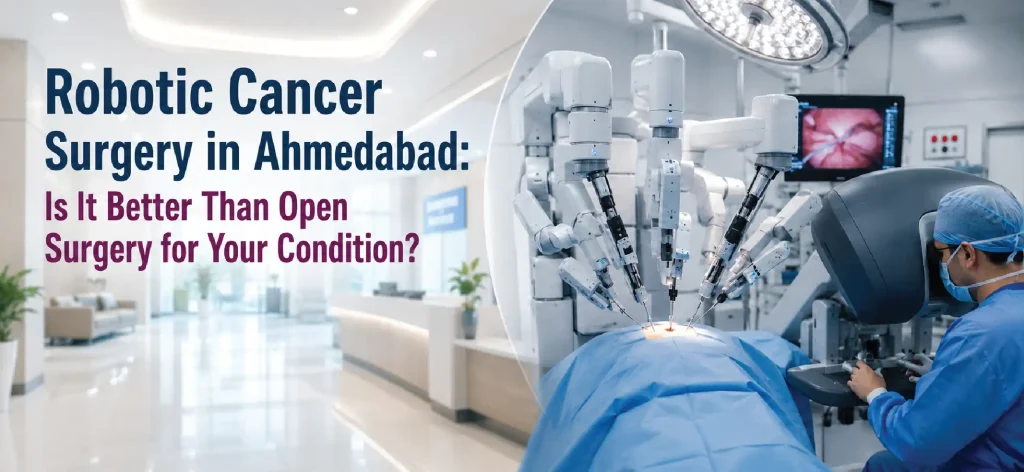
Robotic cancer surgery is a form of minimally invasive cancer surgery where the surgeon operates using a highly advanced robotic system — most commonly the da Vinci Surgical System. The surgeon sits at a console a few feet away from the patient and controls robotic arms fitted with tiny surgical instruments and a high-definition 3D camera.
Importantly, the robot does not operate independently. Every movement is precisely controlled by the surgeon in real time. The robotic system simply enhances the surgeon’s precision, dexterity, and vision — especially in tight anatomical spaces where the human hand has limitations.
How Is It Different From Laparoscopic Surgery?
Both robotic and laparoscopic surgery are minimally invasive — meaning they use small incisions rather than one large opening. However, there are key differences:
- Laparoscopic surgery uses long, straight instruments held by the surgeon directly, with a 2D camera view
- Robotic surgery offers 3D high-definition vision, wristed instrument movement (mimicking the human wrist), tremor filtration, and greater range of motion
- Robotic systems allow surgeons to perform more complex manoeuvres with greater precision, particularly in confined areas like the pelvis or chest
For patients researching robotic vs laparoscopic cancer surgery in Gujarat, the choice often depends on the cancer type, stage, and the surgeon’s expertise with each approach.
Which Cancers Can Be Treated With Robotic Surgery?
Robotic-assisted surgery is used across several cancer types. The most commonly treated cancers include:
- Prostate cancer — one of the most established uses of robotic surgery globally
- Colorectal cancer — including rectal and colon cancers
- Cervical and uterine (gynaecological) cancers
- Kidney cancer — partial or full nephrectomy
- Bladder cancer
- Head and neck cancers — including throat and tongue base tumours
- Gastric (stomach) cancer — in select cases
- Lung cancer — via robotic thoracic surgery
Not every patient with these cancers is automatically a candidate for robotic surgery. Suitability depends on tumour size, stage, location, and overall patient health. Your oncologist and surgical team will assess these factors before recommending an approach.
Robotic Surgery vs Open Surgery: An Honest Comparison
This is the question most patients ask. Here is a balanced, evidence-based comparison:
Advantages of Robotic Surgery Over Open Surgery
- Smaller incisions — reduced surgical trauma to surrounding tissue
- Less blood loss — lower risk of requiring a transfusion
- Shorter hospital stay — many patients are discharged sooner
- Faster recovery — patients often return to daily activities more quickly
- Lower infection risk — smaller wounds reduce exposure
- Less post-operative pain — leading to reduced dependence on pain medication
- Better precision — especially beneficial near nerves, blood vessels, and delicate structures
When Open Surgery May Still Be Preferred
Robotic surgery is not universally superior. Open surgery may be more appropriate when:
- The tumour is very large or has extensively spread to surrounding structures
- Emergency surgical intervention is required
- The patient has had multiple prior abdominal surgeries causing significant scarring
- The robotic approach does not offer a meaningful clinical advantage for a specific cancer type or stage
The goal of cancer surgery — regardless of approach — is complete tumour removal with clear margins. Oncological outcomes remain the primary consideration, not the surgical technique itself.
Benefits of Robotic Cancer Surgery for Patients in Ahmedabad
For patients in Ahmedabad and across Gujarat, access to robotic cancer surgery has practical significance beyond just the clinical benefits.
- Local availability means patients no longer need to travel to Mumbai, Delhi, or Chennai for advanced surgical care
- Reduced hospital stay is especially beneficial for patients travelling from districts like Mehsana, Bhuj, Himmatnagar, or Rajasthan
- Faster recovery allows patients to return home sooner and resume family and work responsibilities
- Reduced caregiver burden — shorter hospitalisations ease the stress on families managing care alongside daily commitments
The cost of robotic surgery for cancer in India varies depending on the cancer type, complexity of the procedure, and the hospital. While robotic surgery may have a higher upfront cost compared to conventional open surgery, the shorter hospital stay, reduced complication rates, and faster recovery can offset overall treatment expenses for many patients. It is advisable to discuss costs and payment options directly with your treating hospital.
Is Robotic Surgery Right for You? Key Considerations
If you are exploring whether robotic surgery is suitable for your situation, here are the questions to discuss with your surgical oncologist:
- What is the stage and location of my tumour? — Robotic surgery is most advantageous for certain tumour locations and stages
- What is your experience with robotic surgery for my cancer type? — Surgeon experience significantly influences outcomes
- What are the alternatives? — Understanding open and laparoscopic options gives you a complete picture
- What are the risks specific to my case? — Every patient’s anatomy and health history is unique
- What outcomes can I realistically expect? — Realistic expectations support better recovery and decision-making
No surgical approach should be chosen based on technology alone. The best surgery for you is the one that offers the safest, most complete removal of your cancer — in the hands of an experienced oncology team.
Zanish Cancer Hospital's Approach to Robotic and Minimally Invasive Cancer Surgery
At Zanish Cancer Hospital, Ahmedabad, the focus has always been on combining surgical precision with genuine patient-centred care. Founded by Dr. Nishant Sanghavi, MS (General Surgery), M.Ch (Surgical Oncology – GCRI Ahmedabad), and Fellowship in Advanced Laparoscopic Surgical Oncology, the hospital brings over a decade of specialised oncology surgical experience to every patient.
The hospital offers minimally invasive cancer surgery in Ahmedabad across multiple cancer types — including gastrointestinal, gynaecological, head and neck, urological, and breast cancers. Every case is assessed through a multidisciplinary tumour board, ensuring treatment decisions are guided by a team of specialists rather than a single opinion.
Zanish Cancer Hospital is equipped with advanced laparoscopic instrumentation, including Storz laparoscopic camera systems, harmonic scalpel, and ligasure vessel sealer — enabling highly precise, minimally invasive procedures. The team’s approach prioritises:
- Thorough pre-surgical evaluation and counselling
- Personalised surgical planning based on tumour characteristics
- Transparent discussion of all available surgical options
- Compassionate post-operative care and recovery support
Patients from Ahmedabad and across Gujarat — including those travelling from Rajasthan and surrounding regions — are welcome to seek a consultation and second opinion at Zanish Cancer Hospital.
Conclusion: Making an Informed Surgical Decision
Robotic cancer surgery represents a meaningful advancement in oncology — offering greater precision, faster recovery, and reduced surgical trauma for many patients. However, it is not the right choice for every cancer or every patient. The decision should always be guided by your cancer type, disease stage, and the expertise of your surgical team.
If you are considering robotic cancer surgery in Ahmedabad or want to understand whether minimally invasive surgery is appropriate for your condition, the most important step is a detailed consultation with an experienced surgical oncologist.
At Zanish Cancer Hospital, Ahmedabad, we are here to answer your questions, explain your options, and support you through every step of your cancer care journey.
Disclaimer: This article is intended for general informational purposes only and does not constitute medical advice. Please consult a qualified healthcare professional or oncologist for guidance specific to your medical condition.
Make Appointment
Address
1st Floor, Viva Atelier, Opp. B.D. Patel House, Near Sardar Patel Statue, Behind Sardar Patel Colony, Naranpura, Ahmedabad-380014. (Gujarat) India
Contact Us
+91 7433852300