
Introduction
A diagnosis of colorectal cancer brings a flood of questions, and one of the most common today is about robotic surgery. Patients in Ahmedabad and across Gujarat are increasingly asking their doctors whether this technology is right for them. This guide explains, in plain language, what colorectal cancer is, why it is becoming more common in India, and how robotic surgery fits into modern treatment — so you can have a more informed conversation with your own surgical team.
What Is Colorectal Cancer?
Colorectal cancer begins in the colon (large intestine) or rectum, usually starting as a small growth called a polyp on the inner lining of the bowel. Not all polyps turn into cancer, but certain types can, slowly, over several years. When they do, the abnormal cells can grow into the bowel wall and, if not caught early, spread to nearby lymph nodes or other organs. Doctors often group colon cancer and rectal cancer together under the term “colorectal cancer” because they share many risk factors and treatment approaches, even though the surgical considerations differ depending on exactly where the tumor is located.
How Common Is Colorectal Cancer In India?
Colorectal cancer ranks as the fourth most common cancer in India among both men and women combined, with national cancer registry data recording roughly 65,000 new cases and over 38,000 deaths in a recent reporting year. It affects men somewhat more often than women. While India’s overall rates remain lower than in many Western countries, the difference that matters most to patients is this: while incidence is falling in several developed nations, it continues to rise in India, particularly in urban areas, where rates run noticeably higher than in rural regions. Projections from global cancer-monitoring bodies suggest India’s colorectal cancer burden could roughly double over the coming decades if current trends continue.
Why Are Cases Increasing?
Several factors are converging:
- Dietary shifts toward red and processed meat, fried foods, and sugar-heavy diets, alongside a decline in fibre intake
- Rising rates of obesity, type 2 diabetes, and sedentary lifestyles
- Increased tobacco and alcohol use
- Longer life expectancy, which means more people live long enough to develop age-related cancers
- A genuinely concerning trend: clinicians across India are seeing more cases in adults under 50, a pattern also being observed worldwide
It’s worth being clear that no single factor “causes” colorectal cancer — it is usually a combination of genetics, lifestyle, and time.
Common Symptoms
Early colorectal cancer often causes no symptoms at all, which is part of why screening matters. As it progresses, possible signs include:
- A persistent change in bowel habits (diarrhea, constipation, or narrower stools) lasting more than a few weeks
- Blood in the stool, or dark/tarry stools
- A sensation that the bowel doesn’t empty completely
- Unexplained weight loss
- Persistent abdominal discomfort, cramping, or bloating
- Unusual fatigue or iron-deficiency anemia found on routine blood tests
These symptoms can also be caused by far more common, non-cancerous conditions — but they should never be self-diagnosed or ignored. A doctor’s evaluation is the only way to know for certain.
Risk Factors
- Age over 45–50 (though younger cases are rising)
- Family history of colorectal cancer or polyps
- Inherited conditions such as Lynch syndrome or familial adenomatous polyposis
- Personal history of inflammatory bowel disease (Crohn’s disease, ulcerative colitis)
- Diets high in red/processed meat and low in fibre
- Obesity, physical inactivity, smoking, and heavy alcohol use
Having one or more risk factors does not mean a person will develop colorectal cancer — it simply means a conversation with a doctor about screening is worthwhile.
Why Early Diagnosis Matters
Colorectal cancer is one of the more treatable cancers when caught at an early stage, largely because it tends to grow slowly and progress through identifiable stages. Polyps can often be removed before they ever become cancerous. Cancers found while still confined to the bowel wall are generally far more manageable than those discovered after spreading to lymph nodes or distant organs. This is why persistent symptoms should prompt a timely visit to a specialist rather than a “wait and see” approach.
How Colorectal Cancer Is Diagnosed
Diagnosis typically involves a combination of:
- Colonoscopy, which allows direct visual examination of the colon and rectum and biopsy of any suspicious tissue
- Blood tests, including markers like CEA, which help with monitoring rather than standalone diagnosis
- Imaging such as CT scans, MRI (especially for rectal cancer, to assess depth and nearby structures), and sometimes PET scans
- Pathology review of biopsy samples to confirm cancer type and grade
Staging — determining how far the cancer has spread — guides every subsequent treatment decision.
Treatment Options
Treatment is personalized based on the cancer’s location, stage, and the patient’s overall health, and often combines more than one approach:
- Surgery to remove the tumor, which remains the primary curative treatment for localized disease
- Chemotherapy, used before or after surgery in many cases, especially for more advanced stages
- Radiation therapy, particularly relevant for rectal cancer to shrink tumors before surgery
- Targeted therapy and immunotherapy, used in specific situations based on tumor genetics
Surgery is where the conversation about robotic technology becomes relevant.
What Is Robotic Colorectal Surgery?
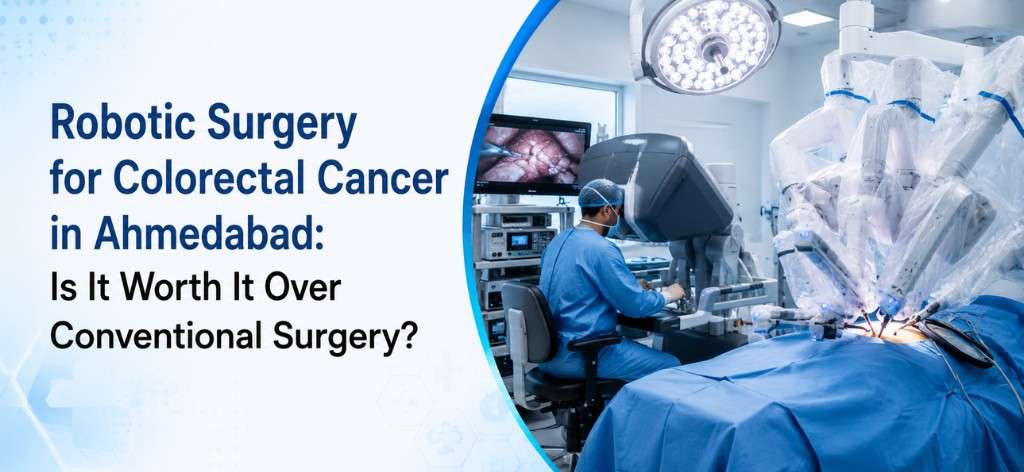
Robotic colorectal surgery is a form of minimally invasive surgery in which the surgeon sits at a console and controls robotic arms holding surgical instruments, viewed through a magnified, high-definition 3D camera. It’s important for patients to understand one thing clearly: the robot does not operate independently. Every cut, stitch, and movement is directed in real time by the surgeon — the system translates the surgeon’s hand movements into smaller, steadier, more precise instrument movements inside the body.
How Does Robotic Surgery Work?
During the procedure, small incisions (usually 5–8mm) are made in the abdomen instead of one large open incision. Robotic arms are inserted through these ports. The surgeon operates from a console nearby, viewing a magnified 3D image of the surgical field, while the robotic wrists replicate hand movements with a wider range of motion than the human wrist allows, and filter out natural hand tremor. The surgical team remains at the bedside throughout, ready to assist or convert to another approach if needed.
Robotic Surgery Vs Open Surgery
Open surgery typically involves one large incision, a direct 2D view of the surgical field, generally higher blood loss, a longer hospital stay, and slower recovery with more post-operative pain.
Robotic surgery typically involves several small incisions, a magnified 3D view, generally lower blood loss, often a shorter hospital stay for suitable patients, and often faster recovery with less post-operative pain in appropriately selected patients.
Robotic Surgery Vs Laparoscopic Surgery
Both are minimally invasive and share many benefits over open surgery. Laparoscopic surgery uses rigid instruments with a limited range of motion, a 2D surgeon-held camera, no tremor filtration, and works well for many standard colon resections.
Robotic surgery uses wristed instruments with a wider range of motion, a stable magnified 3D camera platform, built-in tremor filtration, and is particularly suited to deep pelvic dissection, narrow spaces such as low rectal cancer, and nerve-sparing procedures.
Neither approach is universally “better” — the right choice depends on tumor location, surgeon expertise, and individual patient anatomy.
Benefits Of Robotic Surgery
For appropriately selected patients, robotic surgery may offer smaller incisions and reduced scarring, lower blood loss during surgery, reduced post-operative pain in many cases, potentially shorter hospital stays, improved precision in the narrow, deep space of the pelvis, better visualization for preserving nerves that control bladder and sexual function, and in selected rectal cancer cases, a greater chance of avoiding a permanent stoma through sphincter-preserving techniques.
These are described as possible benefits for suitable candidates, not guaranteed outcomes for every patient — the right surgical approach is always an individual decision made with your surgeon.
Who Is A Suitable Candidate?
Robotic surgery isn’t automatically the right choice for every colorectal cancer patient. Surgeons typically consider tumor location and stage, whether previous abdominal surgeries have caused significant scarring, overall fitness for surgery and anesthesia, and specific anatomical factors, such as pelvic shape in rectal cancer cases.
A thorough evaluation by a surgical oncologist is the only reliable way to determine candidacy.
Recovery After Surgery
Recovery varies by individual, but patients undergoing minimally invasive robotic surgery often experience earlier mobilization, often within a day of surgery, a shorter hospital stay compared to open surgery in many cases, a gradual return to normal diet guided by the surgical team, follow-up care including wound checks, pathology review, and discussion of any further treatment such as chemotherapy, and a structured return to normal activity over several weeks, paced according to the surgeon’s guidance.
Every recovery timeline should be discussed individually with your treating surgeon.
Frequently Asked Questions
Robotic surgery is an established surgical approach used worldwide for colorectal cancer, performed by trained surgical teams with the same safety protocols as any major surgery. As with any operation, individual risk depends on the patient's health and the complexity of the case.
Most patients report less post-operative pain compared to open surgery, largely due to smaller incisions, though some discomfort during recovery is normal after any abdominal surgery.
This varies by patient and procedure complexity, but many patients undergoing minimally invasive robotic surgery recover faster than after open surgery. Your surgeon can give you a personalized estimate based on your specific case.
Not necessarily. Whether a temporary or permanent stoma is needed depends on tumor location and individual anatomy. Robotic precision can help some patients with low rectal cancers avoid a permanent stoma, but this isn't guaranteed for everyone and is decided case by case.
No. Suitability depends on tumor stage, location, prior surgical history, and overall health. Your surgical oncologist will recommend the most appropriate approach for your specific situation.
As with any major surgery, risks include bleeding, infection, anesthesia-related complications, and rarely, the need to convert to open surgery during the procedure. Your surgical team will discuss specific risks relevant to your case.
Any persistent change in bowel habits, blood in stool, unexplained weight loss, or ongoing abdominal discomfort lasting more than a few weeks warrants a visit to a gastroenterologist or surgical oncologist.
Outcomes depend heavily on the stage at diagnosis, tumor biology, and how early treatment begins — which is why early evaluation of symptoms matters more than the specific surgical technology used.
Why Choose Zanish Cancer Hospital In Ahmedabad?
Zanish Cancer Hospital, located in Naranpura, Ahmedabad, is a dedicated surgical oncology and cancer care centre offering a focused, personalized approach to cancer treatment, including colorectal cancer surgery, gastrointestinal cancer care, and minimally invasive surgical options. The hospital’s smaller scale allows for close, continuous involvement from the treating surgical team throughout a patient’s care journey.
About Dr. Nishant Sanghavi
Dr. Sanghavi is the Founder and Director of Zanish Cancer Hospital, Ahmedabad, and also serves as a Consultant Surgical Oncologist at Marengo Asia CIMS Hospital, The Gujarat Research & Medical Institute (Rajasthan Hospital), and Karnavati Superspeciality Hospital. His areas of surgical expertise span gastrointestinal cancer surgery, hepatobiliary and pancreatic cancer surgery, HIPEC (Hyperthermic Intraperitoneal Chemotherapy), robotic and advanced laparoscopic oncosurgery, head and neck cancer surgery, breast cancer surgery, gynaecologic oncology, and soft tissue and sarcoma surgery, with a consistent focus on organ-preservation techniques wherever oncologically appropriate.
He is a Member of the Indian Medical Association (IMA), has presented research at more than 14 national and international scientific conferences, and has published work in surgical oncology, including studies related to pancreatic surgery and oesophageal cancer outcomes.
Conclusion
Colorectal cancer is becoming more common in India, but earlier detection and advances like robotic-assisted surgery mean more patients today have access to treatment options that combine effective cancer control with a faster, more comfortable recovery — when used in the right patient, at the right time. The most important first step is never the choice of surgical technology — it’s not ignoring persistent symptoms and seeking a timely evaluation.
If you or a loved one has been diagnosed with colorectal cancer, consult the specialists at Zanish Cancer Hospital in Ahmedabad to understand the treatment options that may be appropriate for your condition.
Make Appointment
Address
1st Floor, Viva Atelier, Opp. B.D. Patel House, Near Sardar Patel Statue, Behind Sardar Patel Colony, Naranpura, Ahmedabad-380014. (Gujarat) India
Contact Us
+91 7433852300