 Skip to content
Introduction
Receiving a rectal cancer diagnosis is undoubtedly overwhelming, but modern surgical innovations are transforming treatment outcomes and patient experiences. Robotic rectal cancer surgery represents one of the most significant advances in colorectal oncology, offering precision, minimal invasiveness, and improved functional outcomes that weren’t possible with traditional approaches. For patients in Ahmedabad seeking cutting-edge cancer care, understanding how robotic technology enhances rectal cancer treatment can help you make informed decisions about your surgical options. At Zanish Cancer Hospital, we combine advanced robotic surgical systems with specialized expertise to deliver treatment that prioritizes not only cancer cure but also quality of life preservation. This comprehensive guide explores robotic surgery for rectal cancer, its advantages over conventional approaches, what patients can expect, and how this technology is changing the landscape of rectal cancer care in Gujarat.
Understanding Rectal Cancer and Treatment Challenges
Rectal cancer develops in the rectum, the final portion of the large intestine that connects the colon to the anus. Unlike colon cancer, rectal cancer presents unique surgical challenges due to the rectum’s location deep within the narrow confines of the pelvis, surrounded by critical structures including blood vessels, nerves controlling urinary and sexual function, and the sphincter muscles responsible for bowel control.
Key challenges in rectal cancer surgery:
The confined surgical space in the pelvis makes visualization and precise dissection difficult with traditional open surgery or even standard laparoscopic techniques. The proximity of vital nerves means that surgical trauma can result in long-term complications affecting bladder function, sexual function, and bowel control. Additionally, achieving complete tumor removal with adequate margins while preserving the sphincter (when oncologically safe) requires exceptional surgical precision.
These anatomical complexities historically meant that many rectal cancer patients faced permanent colostomies or experienced functional complications after surgery. Robotic technology addresses these challenges through enhanced visualization, precision, and surgical control.
What is Robotic Rectal Cancer Surgery?
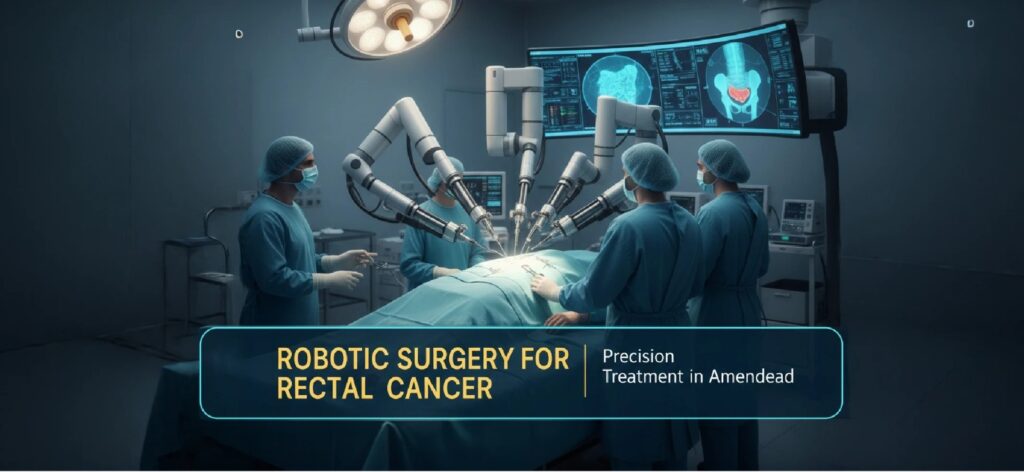
Robotic rectal cancer surgery utilizes advanced robotic surgical systems—most commonly the da Vinci Surgical System—to perform complex rectal cancer operations through small incisions. Unlike traditional open surgery requiring a large abdominal incision, or even standard laparoscopy, robotic surgery offers technological advantages that fundamentally change how surgeons operate in the challenging pelvic environment.
How robotic surgery works:
The surgeon sits at a console, viewing a high-definition, three-dimensional magnified image of the surgical field. Using specialized hand and finger controls, the surgeon manipulates robotic instruments inserted through small incisions. The robotic system translates the surgeon’s hand movements into precise, scaled movements of the surgical instruments inside the patient’s body, while filtering out any hand tremor.
Key technological features:
Three-dimensional, high-definition vision: The robotic camera system provides surgeons with depth perception and 10-15x magnification, enabling clear visualization of tissue planes, blood vessels, and nerves that are difficult to see with conventional techniques.
Enhanced dexterity and range of motion: Robotic instruments have a greater range of motion than the human wrist, articulating 360 degrees and allowing surgeons to operate around corners and in tight spaces with unparalleled precision.
Tremor filtration: The system eliminates natural hand tremor, translating even the finest surgeon movements into steady, precise instrument motions.
Ergonomic advantages: Surgeons operate from a comfortable seated position at the console, reducing fatigue during long, complex procedures and potentially improving surgical performance.
Types of Robotic Procedures for Rectal Cancer
The specific surgical approach depends on tumor location, stage, and individual patient factors. Common robotic procedures for advanced rectal cancer treatment include:
Low anterior resection (LAR): This sphincter-preserving surgery removes the tumor-containing rectum segment and reconnects the remaining colon to the remaining rectum or upper anal canal. It’s the preferred approach when oncologically safe, as it preserves natural bowel function without requiring a permanent colostomy.
Abdominoperineal resection (APR): For very low rectal cancers near or involving the sphincter muscles, complete rectum and anus removal with permanent colostomy creation may be necessary. Robotic technology enables precise pelvic dissection even in these challenging cases.
Total mesorectal excision (TME): This surgical technique involves complete removal of the rectum along with its surrounding fatty tissue envelope (mesorectum) containing lymph nodes. TME is the gold standard for rectal cancer surgery, and robotic assistance facilitates precise, complete mesorectal removal crucial for preventing cancer recurrence.
Intersphincteric resection: For select very low tumors, surgeons can perform ultra-low resections between the internal and external sphincter muscles, preserving the external sphincter and potentially avoiding permanent colostomy.
Advantages of Robotic Surgery Over Traditional Approaches
Research increasingly demonstrates clinical advantages of robotic rectal cancer surgery compared to both open and standard laparoscopic techniques:
Superior visualization in the pelvis: The three-dimensional magnified view enables surgeons to clearly identify and preserve the delicate nerves controlling urinary and sexual function, reducing the risk of these quality-of-life-affecting complications.
More precise dissection: Enhanced instrument control allows surgeons to dissect along the correct tissue planes with greater accuracy, achieving better oncologic outcomes through more complete tumor and lymph node removal.
Improved sphincter preservation rates: Studies suggest robotic surgery may enable sphincter-preserving operations in cases where traditional techniques would require permanent colostomy, preserving natural bowel function and avoiding the psychosocial impact of a stoma.
Reduced blood loss: Precise surgical technique typically results in less bleeding during surgery, reducing transfusion requirements and associated complications.
Faster recovery and shorter hospital stays: Smaller incisions mean less post-operative pain, reduced surgical trauma, earlier mobilization, and typically shorter hospitalizations compared to open surgery.
Lower complication rates: Multiple studies indicate reduced rates of surgical site infections, wound complications, and conversions to open surgery with robotic approaches.
Better functional outcomes: Nerve-sparing rectal surgery performed robotically shows promising results in preserving urinary and sexual function, critical quality-of-life considerations for rectal cancer survivors.
The Robotic Surgery Experience: What to Expect
Understanding the treatment process helps patients prepare mentally and practically for robotic rectal cancer surgery.
Pre-operative preparation: Comprehensive evaluation includes colonoscopy, imaging studies (MRI, CT, PET scans), and sometimes endorectal ultrasound to precisely stage your cancer. Many patients receive neoadjuvant therapy—chemotherapy and/or radiation—before surgery to shrink the tumor and improve surgical outcomes.
The day of surgery: You’ll receive general anesthesia, and the surgical team will position you carefully on the operating table. The surgeon makes several small incisions (typically 5-6 incisions of 8-12mm each) for the robotic instruments and camera. The surgery typically takes 3-5 hours depending on complexity.
Immediate post-operative period: You’ll recover in the post-anesthesia care unit before transferring to your hospital room. Most patients stay in the hospital 4-7 days, depending on their recovery progress.
Recovery timeline: Many patients resume light activities within 2-3 weeks and return to normal activities within 4-6 weeks—significantly faster than the 6-12 week recovery typical of open rectal surgery.
Long-term follow-up: Regular surveillance with physical examinations, CEA blood tests, colonoscopy, and imaging studies monitors for cancer recurrence and manages any treatment-related effects.
Potential Considerations and Limitations
While robotic surgery offers numerous advantages, it’s important to understand that it’s not appropriate for every patient or every situation:
Patient selection matters: Very large, locally advanced tumors may require open surgery for safe removal. Previous abdominal surgeries creating extensive scar tissue can sometimes make robotic approaches challenging.
Learning curve: Robotic rectal surgery is technically demanding, and outcomes are best when performed by surgeons with specialized training and substantial experience in robotic colorectal procedures.
Equipment availability: Robotic surgical systems represent significant hospital infrastructure investments, and access may be limited in some regions.
Not a guarantee: While robotic surgery offers advantages, cancer recurrence risk depends primarily on cancer stage and biology, not surgical technique. All surgical approaches carry risks including bleeding, infection, anastomotic leak, and functional impairments.
Multidisciplinary Care: Beyond Surgery
Optimal rectal cancer outcomes require coordinated multidisciplinary care:
Neoadjuvant therapy: Most patients with locally advanced rectal cancer receive chemotherapy and radiation before surgery to shrink tumors and improve surgical success.
Adjuvant therapy: Post-surgical chemotherapy may be recommended based on pathology findings to reduce recurrence risk.
Stoma care education: Patients requiring temporary or permanent colostomies receive comprehensive education from specialized stoma nurses.
Survivorship care: Long-term follow-up addresses physical recovery, monitors for recurrence, and provides support for psychosocial adjustment and quality of life.
Zanish Cancer Hospital: Leaders in Robotic Oncology Ahmedabad
At Zanish Cancer Hospital, we’ve invested in advanced robotic surgical technology and specialized expertise to provide patients in Ahmedabad and throughout Gujarat with access to world-class minimally invasive rectal surgery.
Our robotic rectal cancer program features:
Expert robotic surgical oncologists: Our fellowship-trained surgical oncologists have completed specialized training in robotic colorectal surgery and have extensive experience performing complex robotic rectal cancer procedures. Their expertise ensures optimal technique and outcomes.
State-of-the-art robotic surgical system: We utilize the latest generation robotic surgical technology, providing surgeons with the most advanced tools available for precision cancer surgery.
Multidisciplinary tumor board: Every rectal cancer patient’s case is reviewed by our team including surgical oncologists, medical oncologists, radiation oncologists, radiologists, and pathologists, ensuring comprehensive, coordinated treatment planning.
Comprehensive colorectal oncology program: Beyond surgery, we provide complete rectal cancer care including chemotherapy, radiation therapy, genetic counseling, nutritional support, and stoma care services.
Focus on functional preservation: Our surgical approach prioritizes not just cancer cure but also quality of life preservation through nerve-sparing rectal surgery techniques and sphincter preservation whenever oncologically appropriate.
Enhanced recovery protocols: We implement evidence-based perioperative care pathways that optimize pain control, nutrition, and early mobilization, accelerating recovery and reducing complications.
Patient education and support: We believe informed patients experience better outcomes. Our team provides thorough education about your diagnosis, treatment options, and what to expect throughout your journey.
Research and innovation: Our participation in clinical research and adoption of evidence-based innovations ensures our patients benefit from the latest advances in robotic colorectal oncology.
Life After Robotic Rectal Cancer Surgery
Recovery and adaptation after rectal cancer surgery varies by procedure type and individual factors:
Bowel function: Most patients with sphincter-preserving surgery experience some temporary bowel frequency and urgency that typically improves over 6-12 months as the remaining intestine adapts.
Quality of life: Studies suggest patients undergoing robotic rectal surgery often report better quality of life outcomes compared to traditional approaches, particularly regarding physical function and body image.
Survivorship: Long-term cancer survival depends primarily on cancer stage at diagnosis. Early-stage rectal cancers have five-year survival rates exceeding 85%, while locally advanced cancers have survival rates of 50-70% with appropriate multimodal treatment.
Ongoing support: Support groups, counseling services, and survivorship programs help patients navigate the physical and emotional aspects of life after cancer treatment.
Conclusion: Precision Treatment for Better Outcomes
Robotic rectal cancer surgery represents a significant advancement in surgical oncology, offering patients the potential for improved cancer outcomes, better functional preservation, and faster recovery compared to traditional surgical approaches. For patients facing rectal cancer in Ahmedabad, access to robotic surgical expertise at Zanish Cancer Hospital means you don’t need to travel to distant metropolitan centers for world-class minimally invasive cancer care.
While rectal cancer remains a serious diagnosis, advances in surgical technology combined with multidisciplinary treatment approaches provide genuine reasons for optimism. The combination of experienced surgical specialists, advanced robotic technology, and comprehensive supportive care creates the foundation for optimal outcomes.
Take action today: If you’ve been diagnosed with rectal cancer or are experiencing symptoms requiring evaluation, contact Zanish Cancer Hospital to schedule a consultation with our robotic surgical oncology team. We’ll provide a thorough assessment, discuss all treatment options including robotic surgery, and develop a personalized care plan designed to achieve the best possible outcome while preserving your quality of life. You deserve expert care delivered with compassion—let us be your partner in fighting rectal cancer.
Medical Disclaimer: This article provides educational information about robotic rectal cancer surgery and should not substitute for professional medical advice. Treatment recommendations depend on individual factors including cancer stage, location, patient health status, and preferences. Surgical outcomes vary, and all surgery carries risks. Always consult qualified colorectal surgical oncologists for diagnosis, treatment planning, and personalized medical guidance specific to your situation.
Make Appointment
Address
1st Floor, Viva Atelier, Opp. B.D. Patel House, Near Sardar Patel Statue, Behind Sardar Patel Colony, Naranpura, Ahmedabad-380014. (Gujarat) India
Contact Us
+91 7433852300
