
Introduction
You have received a cancer diagnosis. A surgeon has recommended an operation. And now — perhaps quietly, perhaps urgently — a question is forming in your mind: Should I get a second opinion before going ahead?
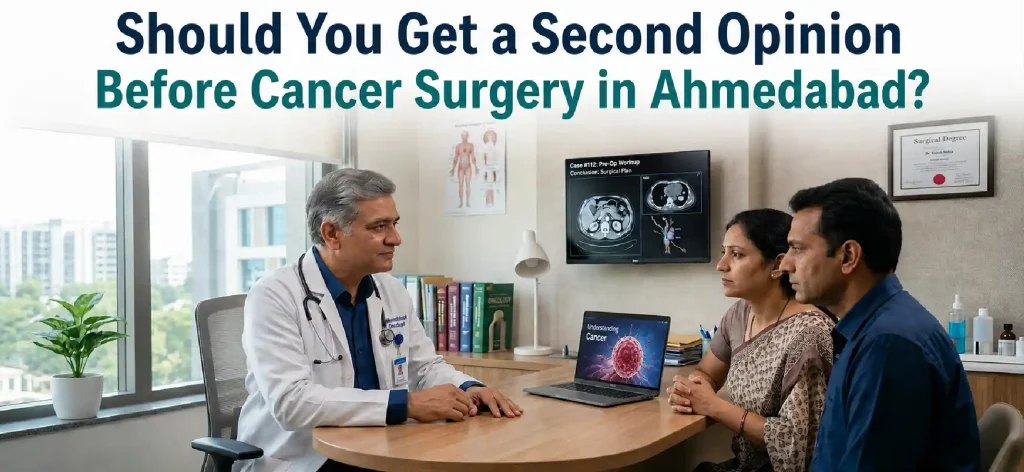
This is one of the most common and most important questions patients ask when considering second opinion cancer surgery in Ahmedabad. And the answer, from experienced surgical oncologists, is almost always the same: yes, in many situations, seeking a second opinion is not only acceptable — it is advisable.
A second opinion is not a sign of distrust towards your current doctor. It is a responsible, medically sound step that helps you feel certain about your diagnosis, your treatment plan, and the surgical approach being recommended. For a decision as significant as cancer surgery, that certainty matters enormously.
This article — written from a surgical oncologist’s perspective — explains when a second opinion is particularly important, how to go about getting one in Gujarat, whether timing is a concern, and what you can realistically expect from the process.
Why Second Opinions Matter in Cancer Care
Cancer treatment — particularly surgery — is rarely a situation where there is only one correct path. Surgical oncology involves nuanced decision-making: which operation to perform, how extensive it should be, whether surgery should come before or after chemotherapy or radiation, and whether minimally invasive techniques are appropriate for your specific case.
Studies consistently show that second opinions in oncology result in changes to diagnosis, staging, or treatment recommendations in a meaningful proportion of cases. This is not because the first opinion was necessarily wrong — it reflects the genuine complexity of cancer care and the fact that different experienced specialists may weigh evidence differently.
For patients in Ahmedabad and across Gujarat, accessing a second opinion locally is now straightforward. You no longer need to travel to Mumbai or Delhi to have your case reviewed by a specialised surgical oncologist.
When Should You Definitely Seek a Second Opinion?
While a second opinion can be valuable in any cancer situation, there are specific circumstances where it is particularly important.
- You Have Been Diagnosed With a Rare or Uncommon Cancer
Rare cancers — such as sarcomas, adrenal tumours, gallbladder cancers, or rare gastrointestinal malignancies — require highly specialised surgical expertise. Not all oncology centres have equal experience with these tumour types. A second opinion from a surgeon who regularly treats your specific cancer can be genuinely practice-changing.
- The Recommended Surgery Is Extensive or Life-Altering
If you have been told you need a surgery that will significantly alter your anatomy or function — such as removal of part of the jaw, a permanent stoma, removal of the bladder or rectum, or amputation of a limb — it is entirely reasonable to want confirmation that this is truly necessary and that less extensive options have been fully considered.
- You Are Uncertain About the Diagnosis Itself
Pathology — the laboratory analysis of biopsy tissue — is the foundation of any cancer diagnosis. Pathology interpretation can occasionally differ between laboratories. If you have any doubt about your diagnosis, requesting a pathology review at a specialised cancer centre is a legitimate and important step.
- You Have Been Told Surgery Is Not Possible
Being told your cancer is inoperable or unresectable is devastating news. However, surgical eligibility can depend significantly on the operating surgeon’s experience and the technology available. A second opinion from a high-volume surgical oncology centre may reveal options that were not considered initially.
- You Feel Rushed or Pressured
A trustworthy oncologist will never pressure you into making an immediate decision about cancer surgery — except in genuine surgical emergencies, which are relatively uncommon in elective oncology settings. If you feel rushed, confused, or inadequately informed, seeking another perspective is entirely appropriate.
- Your Treatment Plan Involves Multiple Modalities
When your recommended treatment involves a combination of surgery, chemotherapy, and radiation — particularly in a specific sequence — a second opinion can confirm that this multimodal approach aligns with current evidence-based guidelines for your cancer type and stage.
Common Concerns Patients Have About Second Opinions
Despite the clear benefits, many patients hesitate to seek a second opinion. Here are the most common concerns — and honest answers to each.
“Will my current doctor be offended?”
Experienced, ethical oncologists understand that second opinions are part of good cancer care. A confident surgeon will not be offended — and if a doctor discourages you from seeking one, that itself is a reason for concern. Your health comes first.
“Will it delay my treatment and make things worse?”
This is a very understandable worry. In the vast majority of cancer cases, taking one to two weeks to obtain a second opinion does not meaningfully affect outcomes. Most solid tumours do not change dramatically over a short period. The exception is a true oncological emergency — which your treating doctor will clearly communicate.
If you are concerned about timing, be transparent when booking your second opinion. Explain the urgency, share your existing reports, and ask specifically how quickly a review can be completed. Most dedicated cancer centres in Ahmedabad can facilitate an urgent second opinion consultation within days.
“Is it too late to get a second opinion before cancer surgery?”
In most cases, no — it is not too late. Even if surgery has been scheduled, patients have the right to pause and seek additional input before proceeding. The only scenario where delay carries genuine risk is a rapidly progressing emergency — and in that case, your surgeon will make this clear with specific clinical reasoning.
“What if the second opinion contradicts the first?”
This can feel confusing, but it is actually valuable information. A difference in opinion between two experienced specialists helps you understand the range of approaches, ask more targeted questions, and make a more informed final decision. In some cases, a third opinion or a multidisciplinary tumour board review can provide further clarity.
How to Get a Second Opinion for Cancer Surgery in Gujarat
The process is simpler than many patients expect. Here is a practical step-by-step guide:
Step 1: Gather your medical records Collect all relevant documents — biopsy reports, scan images (CT, MRI, PET), blood test results, any previous treatment records, and the written treatment recommendation from your current doctor.
Step 2: Contact a specialised surgical oncology centre Look specifically for a centre with a dedicated surgical oncologist — ideally one with M.Ch (Surgical Oncology) qualification and experience in your specific cancer type. General surgeons and surgical oncologists have different levels of specialisation.
Step 3: Request a dedicated second opinion consultation When booking, specify that you are seeking a second opinion before planned surgery. This allows the centre to allocate adequate time for your case review.
Step 4: Bring all original scan discs and reports Digital scan images on CD or USB — not just printed reports — are essential for a meaningful review. A specialist needs to review the actual imaging, not just a written summary.
Step 5: Ask specific questions Come prepared with questions such as:
- Do you agree with the proposed diagnosis and staging?
- Is the recommended surgery the most appropriate approach for my case?
- Are there less extensive surgical options that would achieve equivalent oncological results?
- Would you recommend any changes to the treatment sequence — for example, chemotherapy before surgery?
- Are there minimally invasive surgical options available for my case?
Step 6: Consider a multidisciplinary tumour board review The most comprehensive form of second opinion is a formal tumour board review — where your case is presented to a panel of specialists including surgical, medical, and radiation oncologists, radiologists, and pathologists. Ask whether the centre you are visiting offers this.
What a Surgical Oncologist Considers During a Second Opinion Review
When a surgical oncologist at a specialised centre reviews your case, they will assess:
- Whether the biopsy diagnosis is confirmed and complete — including molecular or genetic markers if relevant
- Whether staging investigations are adequate and correctly interpreted
- Whether the proposed surgery achieves the oncological objective — complete tumour removal with clear margins
- Whether the surgical approach — open, laparoscopic, or robotic — is the most appropriate for your anatomy and tumour characteristics
- Whether neoadjuvant treatment (chemotherapy or radiation before surgery) could improve surgical outcomes or reduce the extent of surgery needed
- Whether reconstruction is indicated and available after tumour removal
This is a thorough, evidence-based review — not a cursory second glance.
Zanish Cancer Hospital's Approach to Second Opinion Consultations
At Zanish Cancer Hospital, Ahmedabad, second opinion consultations are welcomed, respected, and conducted with the same rigour as any new patient assessment. The hospital is led by Dr. Nishant Sanghavi, MS (General Surgery), M.Ch (Surgical Oncology – GCRI Ahmedabad), and Fellowship in Advanced Laparoscopic Surgical Oncology — with over a decade of specialised experience across gastrointestinal, head and neck, gynaecological, urological, and soft tissue cancers.
The hospital’s second opinion process includes:
- Detailed review of all existing investigations — including biopsy pathology, scan imaging, and staging workup
- Multidisciplinary tumour board input — where cases are reviewed collectively by a specialist team before recommendations are made
- Honest, transparent communication — patients are told clearly whether the existing plan is appropriate, whether modifications are advisable, or whether a significantly different approach is recommended
- No pressure, no rush — patients are given the time and information they need to make decisions with confidence
- Accessible appointments — patients from Ahmedabad and across Gujarat, Rajasthan, and neighbouring regions can book consultations by phone, online, or in person
A second opinion at Zanish Cancer Hospital is not about finding fault with previous care. It is about ensuring you have the most complete, expert-reviewed information possible before making one of the most important decisions of your life.
Conclusion: Your Right to Certainty Before Cancer Surgery
Seeking a second opinion before cancer surgery is not disloyalty, delay, or doubt — it is due diligence. It is your right as a patient, and it is supported by the principles of good medical practice.
If you have been recommended cancer surgery in Ahmedabad and want an independent expert review of your diagnosis and treatment plan, do not hesitate to reach out. The clarity a second opinion provides is worth every step of the process.
Zanish Cancer Hospital, Ahmedabad, offers dedicated second opinion consultations for cancer patients across Gujarat. We are here to give you honest answers — so you can move forward with confidence.
Disclaimer: This article is for general informational purposes only and does not constitute medical advice. Please consult a qualified surgical oncologist for evaluation and guidance specific to your individual medical condition and circumstances.
Make Appointment
Address
1st Floor, Viva Atelier, Opp. B.D. Patel House, Near Sardar Patel Statue, Behind Sardar Patel Colony, Naranpura, Ahmedabad-380014. (Gujarat) India
Contact Us
+91 7433852300