
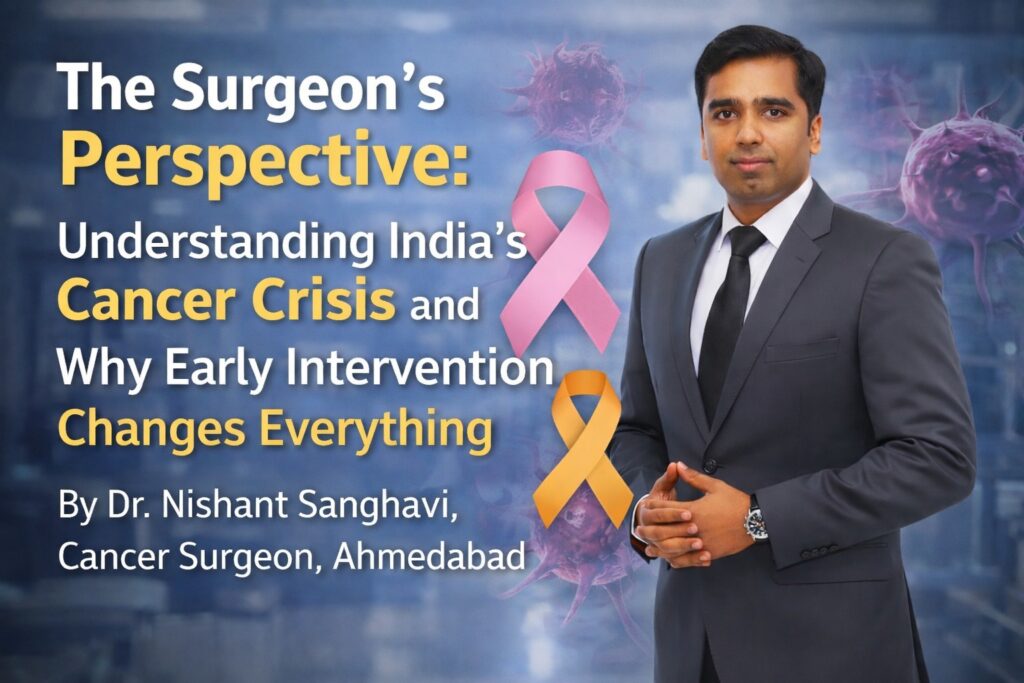
By Dr. Nishant Sanghavi, Cancer Surgeon, Ahmedabad
As a cancer surgeon practicing in Ahmedabad, I witness daily the profound difference that timing makes in cancer outcomes. The conversation I have with a patient diagnosed at stage 1 is vastly different from the one I must have with someone presenting at stage 3 or 4. The surgery I perform, the recovery trajectory, the prognosis, the quality of life—everything changes based on when we catch the disease.
Recent statistics from across India paint a sobering picture that demands our collective attention. Tamil Nadu recently crossed one lakh new cancer cases in a single year—1,00,097 diagnoses in 2025, representing a 45% surge since 2020. Closer to home, the Gujarat Cancer and Research Institute (GCRI) in Ahmedabad registered 26,810 new cancer patients in 2025, with over 2.59 lakh OPD visits. These aren’t just numbers; they represent families forever altered, lives interrupted, and critical moments where early detection could have rewritten the entire story.
The National Landscape: A Growing Health Crisis
India’s cancer burden is escalating at an alarming pace. While improved diagnostic capabilities account for some of this increase, the underlying reality is that lifestyle transitions, environmental factors, and delayed healthcare-seeking behavior are creating a perfect storm for cancer proliferation.
Tamil Nadu's Wake-Up Call
The Tamil Nadu data reveals particularly concerning gender-specific patterns, with women accounting for 53% of cases, primarily breast, cervical, and ovarian cancers. These three cancers alone claimed 10,821 lives in the state during 2025. Among men, tobacco-related mouth cancers continue their devastating prevalence, alongside rising colorectal and stomach cancer rates.
Chennai leads with 8,505 cases, followed by Kancheepuram and Vellore, highlighting how urbanization correlates with cancer incidence. The contributing factors mirror what we observe in Gujarat: lifestyle changes, pollution exposure, chronic stress, dietary shifts, and critically—delayed diagnosis.
Gujarat's Expanding Challenge
Here in Gujarat, GCRI has become a national referral center, with over 9,140 patients traveling from other states—primarily Madhya Pradesh, Rajasthan, and Uttar Pradesh—for treatment. This speaks to both the quality of care available and the overwhelming demand.
The institute performed over 17,800 surgeries in 2025, administered 50,130 chemotherapy procedures, and conducted 5,852 radiation therapy sessions. These figures represent the treatment phase—but as a surgeon, I’m increasingly focused on what happens before patients reach the operating table.
Through the Surgical Lens: What Stage Means
Let me speak plainly about what cancer staging means from a surgical standpoint, because understanding this context can motivate the preventive and screening behaviors that save lives.
Stage 1 Cancer
When we identify cancer at stage 1—localized, small, with no lymph node involvement—the surgical intervention is typically straightforward. For breast cancer, this might mean a lumpectomy (removing just the tumor) rather than mastectomy (removing the entire breast). For colorectal cancer, it could mean minimally invasive laparoscopic surgery rather than extensive bowel resection.
Recovery is faster. Complications are fewer. The need for aggressive chemotherapy or radiation is often minimal or eliminated entirely. Five-year survival rates for most stage 1 cancers exceed 90%. From my operating table, stage 1 cancer is the scenario every surgeon hopes for—not because it’s easy, but because the patient’s prognosis is excellent.
Stage 3-4 Cancer
Contrast this with advanced-stage cancer. The surgery becomes exponentially more complex. We’re not just removing a tumor; we’re dealing with lymph node involvement, potential vascular invasion, and sometimes metastatic spread. The operation takes longer, requires more expertise, carries higher risks, and the patient faces more difficult recovery.
Even after successful surgery, these patients need aggressive adjuvant therapy—intensive chemotherapy regimens, radiation, targeted therapies, immunotherapy. The treatment journey extends from months to years. The side effects are significant. The financial burden is crushing. And despite our best efforts, survival rates drop dramatically.
This is why I’m passionate about early detection. The difference between stage 1 and stage 3 isn’t just medical—it’s life-altering.
The Gujarat Cancer Landscape: What Our Data Reveals
The Ahmedabad urban cancer registry indicates cancer prevalence of 116 cases per lakh population for males and 85 per lakh for females. These numbers, while concerning, actually underestimate the true burden because many cases go undiagnosed or are diagnosed only at advanced stages.
Common Cancers in Gujarat
In my surgical practice and from GCRI’s data, certain patterns emerge:
Among Women:
- Breast Cancer dominates, accounting for the highest proportion of female cancers
- Cervical Cancer remains prevalent despite being highly preventable through HPV vaccination and screening
- Ovarian Cancer often presents late due to vague early symptoms
- Gallbladder Cancer shows higher incidence in North India, including Gujarat
Among Men:
- Oral/Mouth Cancer driven overwhelmingly by tobacco and gutka consumption
- Lung Cancer from smoking and occupational exposures
- Colorectal Cancer rising with dietary changes and urban lifestyles
- Prostate Cancer increasing with aging population and better detection
The Advanced Technology Revolution
GCRI has significantly expanded advanced diagnostic capabilities, with PET-CT scans increasing from 1,813 in 2021 to 6,333 in 2025. This enhanced imaging allows for more precise surgical planning and better treatment outcomes.
The institute performed 50 robotic-assisted cancer surgeries and 40 HIPEC (Hyperthermic Intraperitoneal Chemotherapy) procedures, representing cutting-edge surgical techniques that improve outcomes for complex cancers.
As a cancer surgeon, I’m privileged to practice in an era where technology enhances what we can achieve operatively. But technology alone isn’t the answer—it must be coupled with early detection.
The Early Detection Imperative: Success Stories That Matter
GCRI’s no-cost cancer screening OPD, launched in October 2021, has screened over 50,000 individuals, leading to early detection of 118 cancer cases. Each of those 118 diagnoses represents a life potentially saved through early intervention.
The institute organized 110 community screening camps across Gujarat in 2025, covering over 12,000 people. This proactive approach exemplifies the public health model we need—taking screening to communities rather than waiting for symptomatic patients to seek care.
Let me share what these early detections mean practically:
A 48-year-old woman from Gandhinagar participated in a screening camp and was found to have stage 1 breast cancer through mammography. She underwent breast-conserving surgery, targeted radiation, and is now three years cancer-free, living fully and working actively. Had she waited until she felt a lump, we might be telling a very different story.
A 55-year-old man from Rajkot, asymptomatic but with family history of colorectal cancer, underwent screening colonoscopy. We identified and removed precancerous polyps. He never developed cancer at all—because we intervened at the precancerous stage. This is prevention in its purest form.
Why Patients Delay: Breaking Down the Barriers
In my consultations, I’ve identified consistent patterns in why patients present late:
Fear and Denial
“I was scared to know” is something I hear frequently. The fear of a cancer diagnosis leads people to ignore symptoms, hoping they’ll resolve on their own. This fear, while understandable, can be fatal. The irony is that early diagnosis actually provides the least scary prognosis.
Cost Concerns
Many patients assume cancer treatment is financially devastating and therefore avoid even the diagnostic process. However, early-stage cancer treatment is dramatically less expensive than advanced-stage care. Government schemes, insurance coverage, and institutions like GCRI provide accessible care options.
Lack of Awareness
Many people don’t know what symptoms warrant medical evaluation. A persistent cough, unexplained weight loss, changes in bowel habits—these seem minor until they’re not. Education about warning signs is critical.
Cultural Stigma
In some communities, cancer carries stigma, particularly for women’s cancers. This discourages open discussion and timely care-seeking. We must normalize cancer as a medical condition that deserves prompt, professional treatment without shame or secrecy.
Misplaced Trust in Alternative Remedies
Patients sometimes spend months trying herbal treatments, dietary modifications, or unproven therapies before seeking medical evaluation. While complementary approaches can support conventional treatment, delaying evidence-based diagnosis and intervention allows cancer to progress.
Time Constraints
“I’m too busy” is a dangerous mindset. People postpone screening and ignore symptoms because of work, family obligations, or perceived inconvenience. But cancer doesn’t wait for a convenient time. Making time for health screening is making time to live.
The Warning Signs: A Surgeon's Checklist
From my surgical experience, these are the symptoms that should prompt immediate medical evaluation:
General Warning Signs
- Unexplained weight loss of more than 5% body weight without trying
- Persistent fatigue that doesn’t improve with rest
- Fever of unknown origin lasting more than two weeks
- Pain that persists without clear cause, especially if worsening
Specific Red Flags
Head and Neck:
- Mouth ulcers or white/red patches that don’t heal within three weeks
- Persistent hoarseness or voice changes
- Difficulty swallowing
- Unexplained swelling in the neck
Breast:
- Any new lump or thickening
- Changes in breast size, shape, or symmetry
- Nipple discharge, especially if bloody
- Skin changes—dimpling, puckering, redness, or thickening
- Inverted nipple or nipple changes
Gastrointestinal:
- Changes in bowel habits lasting more than three weeks
- Blood in stool or black, tarry stools
- Persistent abdominal pain or bloating
- Difficulty swallowing
- Persistent heartburn or indigestion
Genitourinary:
- Blood in urine
- Changes in urination pattern
- Abnormal vaginal bleeding, especially postmenopausal
- Pelvic pain or pressure
Respiratory:
- Persistent cough lasting more than three weeks
- Coughing up blood
- Persistent chest pain
- Shortness of breath
Skin:
- Moles that change size, shape, color, or border
- New skin growths or sores that don’t heal
- Changes in existing skin lesions
The Persistence Principle: Occasional symptoms are usually benign. Persistent symptoms—those lasting more than 2-3 weeks despite conservative management—warrant professional evaluation.
Screening Guidelines: Age-Appropriate Recommendations
As a surgeon, I advocate for these evidence-based screening protocols:
For Women
Breast Cancer:
- Monthly self-examination from age 20
- Clinical breast examination annually from age 25
- Baseline mammogram at age 40
- Annual or biennial mammography from age 40-50 depending on risk factors
- Annual mammography from age 50 onward
Cervical Cancer:
- Pap smear every 3 years starting at age 21
- HPV co-testing with Pap smear every 5 years from age 30-65
- HPV vaccination for girls aged 9-14 (also available as catch-up vaccination)
Ovarian Cancer:
- No routine screening for average-risk women
- Genetic counseling for those with family history of ovarian or breast cancer
- BRCA testing if indicated by family history
For Men
Prostate Cancer:
- Discussion with healthcare provider at age 50 about PSA testing
- Earlier discussion (age 40-45) for those with family history
- Shared decision-making about screening frequency based on individual risk
Testicular Cancer:
- Monthly self-examination from age 15-40
- Clinical examination during routine check-ups
For Everyone
Colorectal Cancer:
- Screening starting at age 45 for average-risk individuals
- Colonoscopy every 10 years, or
- Annual fecal immunochemical test (FIT), or
- Stool DNA test every 3 years
- Earlier and more frequent screening for those with family history
Lung Cancer:
- Low-dose CT scan annually for heavy smokers aged 50-80
- Defined as smoking history of 20+ pack-years
Skin Cancer:
- Annual skin self-examination
- Professional skin examination annually for high-risk individuals (fair skin, family history, multiple moles, history of sunburns)
General Health Screening:
- Comprehensive health check-up annually after age 40
- More frequent if risk factors present (family history, tobacco use, obesity, chronic conditions)
Lifestyle Modifications: The Foundation of Prevention
While screening detects cancer early, lifestyle modifications can prevent it from developing in the first place. As a surgeon, I see the consequences of lifestyle choices on the operating table. Here’s what the evidence clearly supports:
- Tobacco Elimination
This cannot be overstated: tobacco is the single most preventable cause of cancer. Whether cigarettes, bidis, gutka, or chewing tobacco, all forms significantly elevate cancer risk. In Gujarat, where gutka and tobacco consumption remain prevalent, oral cancers dominate male cancer statistics.
If you use tobacco in any form, cessation is the most impactful health decision you can make. Cessation support is available through counseling, nicotine replacement therapy, and prescription medications. Even after decades of use, quitting reduces cancer risk.
- Alcohol Moderation
Alcohol is linked to seven different cancer types: mouth, throat, esophagus, liver, colon, rectum, and breast. The relationship is dose-dependent—more consumption means higher risk.
Guidelines suggest no more than one drink daily for women, two for men. But from a cancer prevention standpoint, less is better, and none is best.
- Nutrition Optimization
The traditional Gujarati diet, when balanced and moderate, provides excellent cancer-protective elements:
Increase:
- Colorful vegetables and fruits (5+ servings daily)
- Whole grains, millets, and unprocessed cereals
- Legumes, beans, and lentils
- Nuts and seeds in moderation
- Spices like turmeric, ginger, garlic (natural anti-inflammatory properties)
Decrease:
- Processed and ultra-processed foods
- Red meat (limit to 2-3 servings weekly)
- Processed meats (bacon, sausages, salami—minimize or eliminate)
- Refined sugars and sweetened beverages
- Excessive salt and pickled foods
- Physical Activity
Regular exercise reduces cancer risk through multiple mechanisms: maintaining healthy weight, reducing inflammation, regulating hormones, and enhancing immune function.
Target: 150 minutes of moderate-intensity exercise weekly, or 75 minutes of vigorous activity. This can include brisk walking, cycling, swimming, or traditional activities like yoga and dance.
- Weight Management
Obesity is linked to 13 different cancer types. Maintaining BMI between 18.5-24.9 kg/m² significantly reduces cancer risk. For many patients, weight loss of even 5-10% of body weight yields meaningful health benefits.
- Sun Protection
In Gujarat’s intense climate, sun protection is essential:
- Avoid peak sun hours (10 AM – 4 PM)
- Use broad-spectrum sunscreen (SPF 30+)
- Wear protective clothing and hats
- Regular skin self-examination for suspicious lesions
- Infection Prevention
Certain infections increase cancer risk:
- HPV: Preventable through vaccination (cervical, throat, and other cancers)
- Hepatitis B and C: Preventable through vaccination (Hep B) and avoiding contaminated needles (Hep C)—both linked to liver cancer
- H. pylori: Linked to stomach cancer—treatable if detected
- Stress Management
Chronic stress suppresses immune function and may contribute to cancer development. While the direct link is complex, stress often leads to unhealthy coping behaviors (smoking, drinking, poor diet).
Incorporate stress-reduction practices: meditation, yoga, adequate sleep, social connections, hobbies, and professional counseling when needed.
The Role of Advanced Surgery: When Prevention Isn't Enough
Despite best prevention efforts, cancer sometimes develops. When it does, surgical intervention often forms the cornerstone of curative treatment. Understanding modern surgical approaches helps demystify the process:
Minimally Invasive Surgery
Traditional open surgery has increasingly given way to minimally invasive techniques:
Laparoscopic Surgery: Using small incisions and camera guidance, we can remove cancerous tissues with less trauma, faster recovery, and reduced complications. This is now standard for many colorectal, gynecologic, and urologic cancers.
Robotic Surgery: GCRI’s implementation of robotic-assisted surgery represents cutting-edge technology that enhances precision. The robotic platform provides superior visualization, greater dexterity, and improved access to difficult anatomic locations. For complex pelvic surgeries, prostate cancer, and selected other malignancies, this technology improves outcomes.
Organ-Preserving Approaches
Modern surgical oncology emphasizes preserving function while achieving cancer cure:
Breast-Conserving Surgery: When appropriate for stage and tumor characteristics, lumpectomy plus radiation achieves the same survival as mastectomy while preserving the breast.
Sphincter-Preserving Surgery: For rectal cancer, advanced techniques often allow preservation of anal sphincter function, avoiding permanent colostomy.
Nerve-Sparing Techniques: In prostate cancer surgery, nerve-sparing approaches maintain urinary and sexual function when oncologically safe.
Specialized Procedures
Some advanced cancers require specialized surgical approaches:
HIPEC (Hyperthermic Intraperitoneal Chemotherapy): For selected abdominal cancers with peritoneal spread, HIPEC combines surgical removal of visible tumor with heated chemotherapy delivered directly to the abdominal cavity. This intensive procedure offers hope for patients who previously had limited options.
Complex Resections and Reconstructions: Advanced head and neck cancers, sarcomas, and other complex tumors may require extensive resection followed by sophisticated reconstructive techniques to restore form and function.
The Multidisciplinary Team
Modern cancer surgery doesn’t happen in isolation. Every surgical decision is made within a multidisciplinary team including medical oncologists, radiation oncologists, pathologists, radiologists, and other specialists. This collaborative approach ensures optimal treatment sequencing and comprehensive care.
Financial Considerations: Making Cancer Care Accessible
The cost of cancer treatment is a genuine concern. However, several resources make care more accessible:
Government Resources
GCRI and Other Government Facilities: GCRI provides comprehensive cancer care including surgery, chemotherapy, and radiation at subsidized costs. The no-cost screening OPD exemplifies accessible preventive care.
Ayushman Bharat: India’s national health insurance scheme covers cancer treatment up to ₹5 lakhs annually for eligible families.
State Government Schemes: Gujarat offers various health insurance and support programs for cancer patients.
Insurance Coverage
Most health insurance policies now cover cancer treatment, though specific coverage varies. Review your policy carefully and consider cancer-specific riders if your base coverage is limited.
Charitable Support
Many charitable organizations provide financial assistance for cancer patients. Social workers at cancer hospitals can connect patients with these resources.
Early Detection Reduces Costs
Perhaps the most important financial consideration: early-stage cancer treatment costs a fraction of advanced-stage care. The diagnostic mammogram that detects stage 1 breast cancer might cost ₹1,500-3,000. The treatment might cost ₹1-2 lakhs total. Compare this to advanced breast cancer, where treatment easily exceeds ₹10-15 lakhs and may extend to ₹25-30 lakhs for complex cases.
Screening and early detection are not just medically superior—they’re financially prudent.
Looking Ahead: The Future of Cancer Care in Gujarat
Gujarat’s cancer care infrastructure continues expanding. GCRI’s emergence as a national referral center, the growth in advanced diagnostic and therapeutic capabilities, and the emphasis on community screening represent positive trends.
However, the rising cancer incidence demands continued vigilance:
- Enhanced Screening Programs: Expanding community-based screening to reach rural and underserved populations
- Tobacco Control: Stricter enforcement of tobacco control measures and comprehensive cessation support
- Public Education: Sustained awareness campaigns about warning signs, risk factors, and screening importance
- Infrastructure Development: Additional cancer centers to distribute patient load and improve geographic access
- Research Investment: Understanding Gujarat-specific cancer patterns to tailor prevention and treatment strategies
- Telemedicine Integration: Using technology to extend specialist consultations to remote areas
My Message as a Surgeon: The Power Is in Your Hands
I’ve spent years in operating theaters, fighting cancer with scalpel and suture. I’ve experienced the profound satisfaction of removing stage 1 tumors and watching patients return to full health. I’ve also faced the heartbreak of advanced cancers where, despite our most skilled interventions, the disease has progressed too far.
Here’s what I want you to understand: The most powerful tool against cancer isn’t in my surgical armamentarium—it’s in your hands.
Your choices about tobacco use, alcohol consumption, diet, exercise, and weight management influence your cancer risk more than anything I can do surgically.
Your decision to undergo age-appropriate screening can detect cancer at a stage where cure rates exceed 90%.
Your willingness to seek prompt evaluation of persistent symptoms can catch cancer before it spreads.
The one-lakh-plus cancer cases in Tamil Nadu, the 26,000-plus in Gujarat—these numbers don’t have to be your story. You have agency in this narrative.
Take Action Today
- If you use tobacco, commit to cessation. Reach out for support.
- If you’re overdue for screening, schedule it now. Don’t postpone.
- If you have persistent symptoms, get evaluated. Don’t wait.
- If you have family history of cancer, discuss enhanced screening with your doctor.
- Make lifestyle modifications today. Every healthy choice compounds over time.
- Share this information. Someone in your circle needs to hear this.
Cancer is formidable, but it’s not invincible. Armed with knowledge, empowered by screening, and supported by advancing medical care, we can shift these statistics in a better direction.
As a cancer surgeon, I’m committed to providing the best surgical care possible when cancer occurs. But I’m equally committed to ensuring fewer people need that surgery in the first place.
Early detection saves lives. Lifestyle modification prevents cancer. Prompt evaluation enables cure. The choice, ultimately, is yours.
About the Author: Dr. Nishant Sanghavi is a cancer surgeon practicing in Ahmedabad, Gujarat. He specializes in surgical oncology with expertise in minimally invasive and advanced surgical techniques for various malignancies. Dr.Nishant Sanghavi is committed to patient education, cancer prevention, and making advanced surgical care accessible to all patients.
Disclaimer: This article is for educational and informational purposes only and should not be considered medical advice. Always consult with a qualified healthcare provider for personalized medical evaluation, diagnosis, and treatment recommendations tailored to your individual health circumstances.
Make Appointment
Address
1st Floor, Viva Atelier, Opp. B.D. Patel House, Near Sardar Patel Statue, Behind Sardar Patel Colony, Naranpura, Ahmedabad-380014. (Gujarat) India
Contact Us
+91 7433852300