
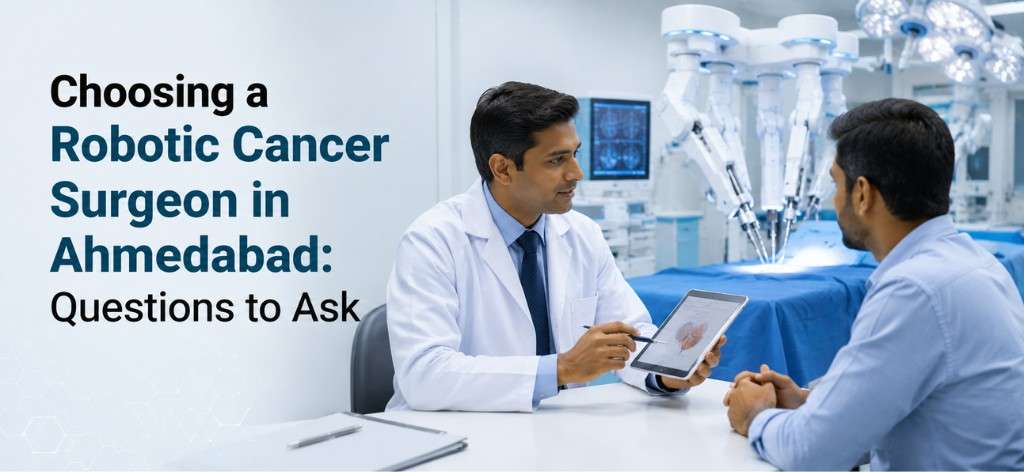
When cancer surgery becomes part of a treatment plan, choosing the right surgeon is an important decision. Patients and families may come across terms such as robotic surgery, robotic-assisted surgery and minimally invasive cancer surgery while researching their options.
But choosing a robotic cancer surgeon in Ahmedabad should involve more than looking for a hospital that has robotic technology.
The surgeon’s experience with the specific cancer, understanding of the patient’s condition, ability to explain treatment options and access to comprehensive cancer care all matter. Patients should also understand why robotic surgery is being recommended and whether another surgical approach may be more appropriate.
A good consultation should leave you with a clear understanding of your diagnosis, the proposed operation, possible alternatives, expected recovery and the reasons behind the recommended treatment.
What Is Robotic Cancer Surgery?
Robotic cancer surgery is a form of minimally invasive surgery in which a surgeon controls specialised instruments through a robotic surgical system.
The robotic system does not independently diagnose cancer or decide how the operation should be performed. The surgeon remains responsible for planning and performing the procedure.
Robotic technology can provide enhanced visualisation and controlled instrument movement during selected operations. Whether these features are beneficial depends on the type of cancer and the surgical procedure being considered.
Robotic surgery may be used for selected cancers involving areas such as:
- Prostate
- Kidney
- Colorectal region
- Gastrointestinal system
- Uterus and other gynaecological organs
- Head and neck region
- Other selected cancer procedures
The appropriate surgical approach depends on the patient’s diagnosis, cancer stage, tumour location, overall health and the complexity of the operation.
Questions to Ask a Robotic Cancer Surgeon Before Surgery
A consultation is an opportunity to understand your treatment rather than simply receive a recommendation.
Consider asking the following questions.
Do You Treat My Type of Cancer?
Robotic surgery is not one single procedure.
A surgeon may have experience with robotic surgery but not necessarily with every type of robotic cancer operation.
Ask the surgeon about their experience treating your specific cancer and performing the particular procedure being proposed.
This can help you understand whether their experience is relevant to your diagnosis.
Why Are You Recommending Robotic Surgery for Me?
This is one of the most important questions to ask.
A good explanation should relate the surgical approach to your diagnosis and treatment goals.
Ask:
- What makes robotic surgery suitable for my case?
- What is the goal of the operation?
- How does the robotic approach fit into my overall cancer treatment?
- Would another surgical approach also be appropriate?
The answer should be based on your medical circumstances rather than simply the availability of robotic technology.
What Are My Other Surgical Options?
Patients should understand that robotic surgery may not be the only option.
Depending on the cancer and procedure, alternatives may include:
- Open surgery
- Conventional laparoscopic surgery
- Other minimally invasive approaches
- Non-surgical treatment in selected situations
Ask your surgeon to explain the relevant alternatives and why one approach is being recommended over another.
Understanding the alternatives can make the decision more informed.
What Experience Should You Ask About?
When patients search for the best robotic surgery hospital in Ahmedabad, they may focus on the hospital’s technology and facilities.
Those factors matter, but the surgeon’s relevant experience also deserves attention.
Ask about experience in:
Your Specific Cancer
Experience should be relevant to the cancer you have, not simply robotic surgery in general.
Your Planned Procedure
Different robotic procedures involve different anatomical challenges and surgical techniques.
Complex Cases
Ask whether the surgeon regularly manages cases similar to yours and how complex situations are approached.
Multidisciplinary Cancer Care
Cancer treatment may involve surgical oncology, medical oncology, radiation oncology, radiology and pathology.
A surgeon should be able to explain how your operation fits into the wider treatment plan.
Does Robotic Surgery Guarantee a Better Outcome?
No surgical technology can guarantee a particular outcome.
Robotic surgery may provide advantages in selected procedures, but the expected benefit depends on the patient’s diagnosis and the type of operation.
The surgeon should explain:
- Potential benefits
- Possible risks
- Limitations
- Alternatives
- Expected recovery
- Possibility of additional treatment
Be cautious of claims suggesting that robotic surgery automatically means a safer operation, faster recovery or better cancer control for every patient.
Cancer treatment needs to be individualised.
What Role Does Cancer Staging Play?
Cancer staging helps doctors understand the extent of disease and plan appropriate treatment.
The stage can influence whether surgery is recommended and which surgical approach may be suitable.
For some patients, surgery may be one part of a broader treatment plan involving chemotherapy, radiation therapy, targeted therapy, immunotherapy or other treatments.
Therefore, choosing a surgeon should not be separated from understanding the complete cancer treatment strategy.
How Important Is the Surgeon’s Communication?
Communication is an important part of cancer care.
You should feel comfortable asking questions and discussing concerns with your surgeon.
A good consultation should allow you to understand:
- Your diagnosis
- The purpose of surgery
- The proposed surgical approach
- Potential risks
- Alternatives
- Recovery expectations
- Additional treatment that may be required
- Follow-up care
If the explanation is unclear, ask the surgeon to explain it again.
You can also bring a family member or caregiver to the consultation if that helps you remember information and discuss decisions later.
What Questions Should You Ask About Recovery?
Before surgery, ask what recovery may involve.
Your surgeon can explain:
- Expected hospital care
- Pain management
- Wound care
- Activity restrictions
- Follow-up appointments
- When normal activities may gradually resume
- Warning signs that require medical attention
Recovery varies from patient to patient.
The extent of surgery, overall health, complications and additional cancer treatment can all influence the recovery process.
Avoid comparing your expected recovery directly with another patient’s experience.
How Should You Compare Cancer Surgeons in Ahmedabad?
When comparing surgeons, consider the complete picture rather than one credential or one technology.
What to Compare | What to Look For |
Cancer expertise | Experience relevant to your specific cancer |
Surgical expertise | Experience with the proposed procedure |
Robotic experience | Relevant experience with robotic-assisted surgery |
Treatment planning | Clear explanation of why surgery is recommended |
Alternatives | Willingness to discuss other appropriate approaches |
Cancer care | Access to multidisciplinary oncology services |
Communication | Clear and patient-friendly explanations |
Safety | Transparent discussion of risks and limitations |
Follow-up | Clear plan for post-operative and oncology care |
Hospital support | Appropriate surgical, diagnostic and critical-care facilities |
The purpose of this comparison is not to identify a surgeon through a single ranking or label.
It is to determine whether the surgeon and hospital are appropriate for your particular cancer treatment needs.
Red Flags to Watch For When Choosing a Cancer Surgeon
Patients should be cautious when a consultation includes:
Guaranteed Results
Cancer treatment cannot be guaranteed to produce a particular outcome.
Pressure to Decide Immediately
Patients should have an opportunity to understand the treatment and ask questions before making an informed decision.
Technology-First Recommendations
Robotic surgery should be recommended because it is clinically appropriate, not simply because robotic equipment is available.
No Discussion of Alternatives
A meaningful surgical consultation should address appropriate alternatives when they exist.
Unclear Costs
Patients should receive clear information about expected treatment expenses and what may or may not be included.
No Discussion of Risks
Every surgical procedure has potential risks. These should be explained honestly.
Should You Get a Second Opinion?
A second opinion can be helpful when you are uncertain about a diagnosis, proposed surgery or treatment plan.
It may help you:
- Confirm the diagnosis
- Understand the recommended operation
- Explore alternative approaches
- Understand whether robotic surgery is appropriate
- Clarify expected risks and recovery
- Feel more confident about your treatment decision
Seeking another opinion does not mean that you distrust your original doctor.
For major cancer surgery, patients may reasonably want to understand their options before proceeding.
How to Prepare for Your Surgical Consultation
Preparing your questions in advance can make the consultation more useful.
Bring relevant medical records, such as:
- Biopsy or pathology reports
- Imaging reports and available scans
- Previous treatment records
- Medication information
- Relevant medical history
- Insurance information, where appropriate
You can also write down your most important questions before the appointment.
If possible, take notes during the consultation or have a trusted family member accompany you.
What Makes a Good Robotic Cancer Surgeon?
A suitable robotic cancer surgeon should bring together more than technical knowledge of a robotic system.
Important qualities include:
- Expertise in the relevant cancer
- Experience with the proposed surgical procedure
- Understanding of cancer staging and treatment planning
- Ability to discuss benefits and limitations honestly
- Willingness to explain alternative approaches
- Clear communication with patients and families
- Collaboration with other oncology specialists
- Commitment to appropriate follow-up care
The best choice is not necessarily the surgeon who makes the strongest promotional claims.
It is the surgeon who can explain your treatment clearly, assess your individual circumstances and recommend an approach based on sound clinical reasoning.
Choosing a Robotic Surgery Hospital in Ahmedabad
The hospital where surgery is performed is also an important consideration.
When evaluating a cancer hospital, look beyond the availability of robotic equipment.
Consider whether the hospital provides:
Comprehensive Cancer Services
Patients may require more than surgery during their cancer journey.
Multidisciplinary Expertise
Access to different oncology specialties can support coordinated treatment planning.
Diagnostic Support
Accurate imaging and pathology are important for cancer diagnosis, staging and treatment planning.
Surgical and Anaesthesia Support
Robotic surgery requires an appropriately trained surgical and anaesthesia team.
Post-Operative Care
Patients should have access to appropriate monitoring, nursing care and medical support following surgery.
Transparent Patient Communication
The hospital should clearly explain the treatment plan, expected care, possible risks and financial considerations.
Expert Insight
When choosing a robotic cancer surgeon, patients should ask a simple but important question:
“Why is this surgical approach appropriate for my cancer?”
The answer should connect the technology to your diagnosis, cancer stage, tumour location, treatment goals and overall health.
A surgeon’s experience with robotic surgery is valuable, but it should be relevant to the operation you actually need. Equally important is the surgeon’s ability to recognise when robotic surgery is not the most appropriate option.
Patients should also look beyond the operation itself. Cancer treatment may involve pathology, medical oncology, radiation oncology, imaging and long-term follow-up. The surgeon and hospital should be able to explain how these services fit together.
For patients in Ahmedabad and across Gujarat, choosing a cancer surgeon should therefore be an informed medical decision rather than a technology-based decision.
Key Takeaways
- Choosing a robotic cancer surgeon involves more than selecting a hospital with robotic technology.
- Look for experience relevant to your specific cancer and proposed procedure.
- Ask why robotic surgery is appropriate for your individual case.
- Understand the available surgical alternatives.
- Ask about potential risks, limitations and recovery.
- Do not rely on guaranteed outcomes or promotional claims.
- Consider the hospital’s wider multidisciplinary cancer-care services.
- Ask how surgery fits into your complete cancer treatment plan.
- A second opinion can be considered when you remain uncertain about the proposed treatment.
- The right surgical approach should be based on clinical suitability and individual patient needs.
Frequently Asked Questions
Look for a surgeon with relevant expertise in your specific cancer and experience with the proposed procedure. Ask about their approach to robotic surgery, alternatives, potential risks, recovery and multidisciplinary cancer care.
Ask why robotic surgery is recommended, what alternatives are available, how experienced the surgeon is with your type of cancer and procedure, what risks may apply to your case and what recovery may involve.
Relevant robotic surgery experience is important, but it should be considered alongside cancer-specific expertise, experience with the proposed operation, clinical judgement and access to comprehensive cancer care.
A second opinion may be useful if you are uncertain about the diagnosis, proposed surgery or available treatment options. It can help you better understand the recommendation and make a more informed decision.
Consider the surgical team's cancer expertise, relevant robotic experience, multidisciplinary oncology services, diagnostic facilities, surgical support, post-operative care and transparency about treatment planning. The presence of robotic technology alone should not determine your choice.
Conclusion
Choosing a robotic cancer surgeon in Ahmedabad is an important decision that deserves careful consideration.
Robotic surgery can be a valuable minimally invasive approach for selected cancer procedures, but the technology itself should not be the deciding factor. What matters is whether the approach is appropriate for your cancer and whether the surgeon has the relevant expertise to perform the proposed procedure.
Before making a decision, ask about the surgeon’s experience, the reason robotic surgery has been recommended, alternative surgical options, potential risks, recovery and the wider cancer treatment plan.
It is equally important to consider the hospital’s multidisciplinary oncology services and ability to support you before, during and after surgery.
Taking time to ask the right questions can help you understand your options and participate more confidently in your cancer treatment decisions.
Speak With the Oncology Team at Zanish Cancer Hospital
If you are considering robotic cancer surgery in Ahmedabad, a consultation can help you understand whether this approach is appropriate for your diagnosis and treatment plan.
At Zanish Cancer Hospital, Ahmedabad, discuss your diagnosis, surgical options, robotic-assisted treatment, potential risks and the overall cancer-care pathway with the oncology team.
Make Appointment
Address
1st Floor, Viva Atelier, Opp. B.D. Patel House, Near Sardar Patel Statue, Behind Sardar Patel Colony, Naranpura, Ahmedabad-380014. (Gujarat) India
Contact Us
+91 7433852300