
Introduction
Being told you need surgery for colon or rectal cancer raises immediate and understandable fears. Will it be a major operation? How long will recovery take? Which surgical approach is safer? These are questions that every patient and family member deserves honest, clear answers to.
If you are exploring colon cancer surgery in Ahmedabad, you will likely encounter two terms — laparoscopic and robotic surgery. Both are minimally invasive alternatives to traditional open surgery, and both have transformed outcomes for colorectal cancer patients in recent years. But they are not identical, and understanding the differences can help you have a more meaningful conversation with your surgical team.
This article explains what colon and rectal cancer surgery involves, compares laparoscopic and robotic approaches in straightforward terms, outlines what patients can expect during recovery, and guides you on how to find the right colorectal cancer specialist in Ahmedabad. Whether you have just received a diagnosis or are seeking a second opinion, this information is designed to support your decision-making — not replace medical advice.
Understanding Colon and Rectal Cancer
Colorectal cancer refers to cancers that develop in the colon (large intestine) or the rectum — the final section of the digestive tract. Together, they are among the most commonly diagnosed cancers in India, with incidence rates rising steadily due to changing dietary habits, sedentary lifestyles, and increased awareness leading to more frequent diagnosis.
Common Symptoms to Watch For
Colorectal cancer symptoms can be subtle in the early stages. Key warning signs include:
- Persistent change in bowel habits — including diarrhoea, constipation, or narrowing of stools lasting more than a few weeks
- Blood in the stool — either bright red or dark and tarry
- Unexplained abdominal discomfort, cramping, or pain
- A feeling that the bowel does not empty completely
- Unexplained weight loss and fatigue
- Anaemia without an obvious cause
Many of these symptoms overlap with non-cancerous conditions. However, if you or a family member in Ahmedabad or Gujarat is experiencing any of these signs persistently, seeking prompt evaluation from a colorectal specialist is strongly advised.
Key Risk Factors
- Age above 50 years (though younger adults are increasingly affected)
- A personal or family history of colorectal cancer or polyps
- Inflammatory bowel disease — Crohn’s disease or ulcerative colitis
- A diet high in red and processed meat, low in fibre
- Sedentary lifestyle and obesity
- Smoking and excessive alcohol consumption
- Certain inherited genetic syndromes such as Lynch syndrome or FAP (Familial Adenomatous Polyposis)
How Is Colon Cancer Diagnosed and Staged?
Accurate diagnosis and staging are essential before any surgical decision is made. The diagnostic process for colorectal cancer treatment in Gujarat typically involves:
- Colonoscopy with biopsy — direct visualisation of the colon and rectum; allows tissue sampling for histological confirmation
- CT scan of abdomen and pelvis — to assess tumour size, location, and local spread
- MRI of the pelvis — particularly important for rectal cancer to evaluate the relationship of the tumour to surrounding structures
- PET scan — to detect distant metastases when indicated
- CEA blood test — carcinoembryonic antigen; a tumour marker used in monitoring treatment response and recurrence
Staging from Stage I to Stage IV determines whether surgery alone is sufficient or whether additional treatments like chemotherapy or radiation are needed before or after surgery.
Surgical Treatment for Colon and Rectal Cancer
Surgery remains the cornerstone of curative treatment for most stages of colorectal cancer. The goal is complete removal of the tumour along with a margin of healthy tissue and the associated lymph nodes — a procedure known as oncological resection.
Types of Colon Cancer Surgery
Depending on the tumour’s location and the patient’s overall health, surgical options include:
- Right hemicolectomy — removal of the right portion of the colon; for cancers in the ascending colon or caecum
- Left hemicolectomy — removal of the left portion; for descending colon cancers
- Sigmoid colectomy — removal of the sigmoid colon; for sigmoid colon cancers
- Anterior resection — removal of the upper rectum; for upper and mid rectal cancers
- Low anterior resection (LAR) — removal of the mid to lower rectum; often requires a temporary stoma
- Abdominoperineal resection (APR) — removal of the rectum and anus; for very low rectal cancers where sphincter preservation is not possible
The choice of procedure depends on tumour location, stage, and whether sphincter-preserving surgery is oncologically safe.
Laparoscopic vs Robotic Colon Cancer Surgery: Understanding the Difference
Both laparoscopic and robotic approaches are forms of minimally invasive surgery — meaning the surgeon operates through small incisions rather than a large open cut. However, they differ in important ways.
Laparoscopic Colon Cancer Surgery
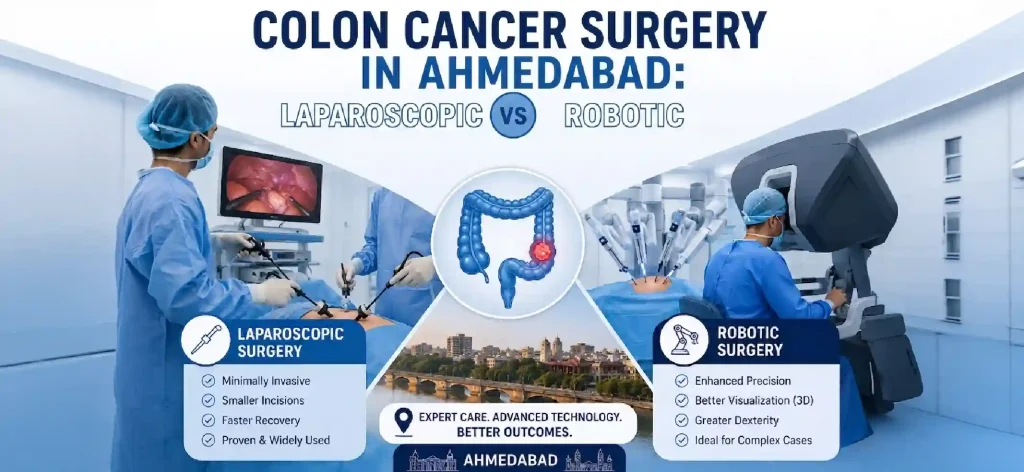
In laparoscopic surgery, the surgeon uses long, straight instruments inserted through small ports in the abdomen, guided by a 2D camera on a screen. It is a well-established, widely practised technique with an extensive evidence base for colorectal cancer.
Advantages over open surgery:
- Smaller incisions and reduced surgical trauma
- Shorter hospital stay — typically 3–5 days versus 7–10 days for open surgery
- Less post-operative pain and reduced need for strong pain relief
- Lower risk of wound infection and hernia
- Faster return to normal diet and daily activities
Laparoscopic surgery is the current standard of care for minimally invasive colorectal resection at many experienced centres.
Robotic Colorectal Surgery in Ahmedabad
Robotic surgery adds another layer of precision to minimally invasive colorectal procedures. The surgeon operates from a console using robotic arms with wristed instrument movement, 3D high-definition vision, and tremor filtration — providing greater dexterity in confined spaces.
Where robotic surgery offers a particular advantage:
- Rectal cancer surgery — the pelvis is a narrow, confined space; robotic instruments navigate this anatomy more precisely than straight laparoscopic tools
- Nerve-sparing dissection — critical for preserving bladder and sexual function after rectal cancer surgery
- Obese patients — where abdominal depth makes laparoscopic manoeuvring more difficult
- Complex or re-operative cases — where precise dissection in scarred tissue is necessary
Which Approach Is Better?
The honest answer is: it depends on your specific case. For straightforward colon cancer in suitable patients, laparoscopic surgery delivers excellent oncological and recovery outcomes. For rectal cancer — particularly low rectal tumours requiring precise pelvic dissection — robotic surgery may offer meaningful advantages in nerve preservation and functional outcomes.
Recovery time after colon cancer surgery in Gujarat is broadly similar for both minimally invasive approaches — most patients are mobile within 24 hours, eating within 2–3 days, and discharged within 4–6 days. Full recovery varies by individual but is generally faster than open surgery.
The decision between robotic and laparoscopic surgery should be guided by:
- Tumour location — colon versus rectum, and level within the rectum
- Stage and complexity of the case
- Patient anatomy and BMI
- Surgeon’s training and experience with each technique
- Availability of technology at the treating centre
What to Look for in a Colon Cancer Surgeon in Ahmedabad
Choosing the right rectal cancer specialist in Ahmedabad is as important as choosing the right surgical technique. Here is what patients and families should consider:
- Subspecialty training in colorectal or surgical oncology — not all general surgeons have dedicated oncology training
- Experience with both laparoscopic and robotic colorectal procedures
- Multidisciplinary team support — your surgeon should work alongside medical oncologists, radiation oncologists, radiologists, and pathologists
- Clear pre-operative counselling — including honest discussion of stoma possibility, functional outcomes, and realistic recovery expectations
- Access to neoadjuvant therapy — chemotherapy or radiation before surgery for locally advanced rectal cancer is often standard of care; your hospital should facilitate this
- Willingness to offer a second opinion — a confident, trustworthy surgical team will always support patients seeking additional perspectives
Zanish Cancer Hospital's Approach to Colorectal Cancer Surgery
At Zanish Cancer Hospital, Ahmedabad, colorectal cancer patients receive structured, multidisciplinary care from the point of diagnosis through to post-operative recovery. The hospital is led by Dr. Nishant Sanghavi, MS (General Surgery), M.Ch (Surgical Oncology – GCRI Ahmedabad), and Fellowship in Advanced Laparoscopic Surgical Oncology — with over a decade of specialised experience in gastrointestinal and colorectal cancer surgery.
The hospital’s approach to colon and rectal cancer surgery includes:
- Tumour board review for every new case — ensuring treatment decisions reflect collective specialist expertise
- Advanced minimally invasive surgical capabilities — including laparoscopic colorectal resection using Storz laparoscopic systems, harmonic scalpel, and ligasure vessel sealer
- Personalised surgical planning — based on tumour location, stage, patient fitness, and functional priorities
- Transparent stoma counselling — patients are clearly informed about the possibility and nature of a stoma before surgery, with dedicated support
- Coordinated access to chemotherapy and radiation — for patients requiring neoadjuvant or adjuvant treatment as part of their care plan
- Post-operative follow-up and surveillance — structured monitoring to detect recurrence early
Patients from Ahmedabad and across Gujarat — including those travelling from Surat, Vadodara, Rajkot, Mehsana, and Rajasthan — are welcome to seek consultation or a second opinion.
Conclusion: Making the Right Surgical Decision for Your Colon Cancer
Colon and rectal cancer surgery has advanced significantly, with minimally invasive approaches now offering patients faster recovery, less pain, and comparable oncological outcomes to open surgery. Whether laparoscopic or robotic surgery is right for you depends on your individual diagnosis, tumour characteristics, and the expertise of your surgical team.
If you are navigating a colorectal cancer diagnosis and want to understand your surgical options clearly, the most important step is a consultation with an experienced colorectal oncologist.
At Zanish Cancer Hospital, Ahmedabad, we are committed to giving you honest guidance, personalised care, and the surgical expertise your situation deserves.
Disclaimer: This article is intended for general informational purposes only and does not constitute medical advice. Always consult a qualified oncologist or colorectal surgeon for personalised diagnosis and treatment recommendations.
Make Appointment
Address
1st Floor, Viva Atelier, Opp. B.D. Patel House, Near Sardar Patel Statue, Behind Sardar Patel Colony, Naranpura, Ahmedabad-380014. (Gujarat) India
Contact Us
+91 7433852300