
Introduction
When a colorectal cancer diagnosis is confirmed, one of the first questions patients and families ask is: what kind of surgery is best? Robotic colorectal surgery in Ahmedabad is increasingly becoming the preferred choice for eligible patients — but is it genuinely better than conventional open surgery, or is it simply a newer, more expensive option?
This is a fair and important question. Surgery for colorectal cancer — which involves the colon, rectum, or both — is a major medical decision. The surgical approach chosen can affect recovery time, complication risk, bowel function, and quality of life. Understanding the real differences between robotic, laparoscopic, and open surgery helps patients make informed decisions alongside their medical team.
This article breaks down what robotic surgery for colorectal cancer involves, how it compares to conventional methods, who is a suitable candidate, and why patients across Gujarat are choosing Zanish Cancer Hospital in Ahmedabad for their colorectal oncology care.
Understanding Colorectal Cancer and the Role of Surgery
Colorectal cancer develops in the lining of the colon or rectum and is one of the more commonly diagnosed cancers in India. Surgery remains the primary treatment for most non-metastatic cases, often combined with chemotherapy or radiation therapy depending on the stage and location of the tumor.
The goal of colorectal cancer surgery is to remove the tumor along with a margin of healthy tissue and nearby lymph nodes. How that surgery is performed — open, laparoscopic, or robotic — depends on tumor location, stage, patient health, and the surgical team’s expertise.
Three Surgical Approaches: A Clear Comparison
Open Surgery (Conventional)
Open surgery involves a single large incision in the abdomen. It gives the surgeon direct, unobstructed access to the colon and rectum. For decades, this was the standard approach and remains an effective option, particularly for advanced or complicated cases.
Advantages:
- Familiar technique with a long track record
- Suitable for complex tumor involvement
- Does not require specialized robotic equipment
Limitations:
- Larger incision leads to more post-operative pain
- Longer hospital stay
- Higher risk of wound complications
- Extended recovery period
Laparoscopic Surgery (Minimally Invasive)
Laparoscopic surgery uses small incisions through which a camera and surgical instruments are inserted. The surgeon views the operating field on a monitor. It represented a major step forward from open surgery and is now widely practiced.
Advantages:
- Smaller incisions and less scarring
- Reduced blood loss
- Faster recovery compared to open surgery
- Shorter hospital stay
Limitations:
- Two-dimensional visualization limits depth perception
- Restricted instrument movement in narrow pelvic areas
- Technically challenging for rectal cancers low in the pelvis
Robotic Surgery (Advanced Minimally Invasive)
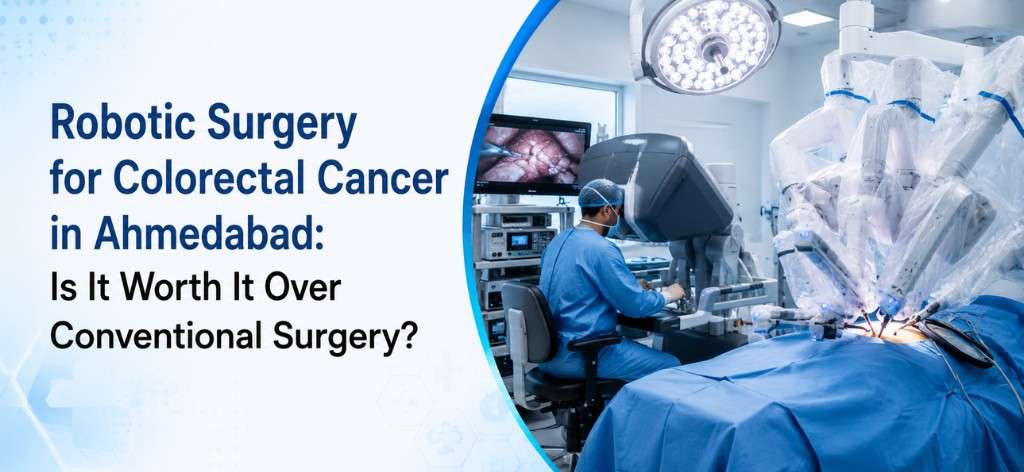
Robotic surgery, performed using a robotic surgical system, extends the capabilities of laparoscopic surgery. The surgeon operates from a console, controlling robotic arms with wristed instruments that move with greater range and precision than human hands alone.
Advantages:
- Three-dimensional, high-definition visualization of the operative field
- Wristed instruments allow movement in confined spaces like the pelvis
- Tremor filtration improves precision during delicate dissections
- Reduced blood loss and lower transfusion rates in eligible patients
- Potential for nerve-sparing surgery, important for preserving bladder and sexual function
- Smaller incisions and faster return to normal activity for many patients
Limitations:
- Not suitable for every patient or tumor type
- Longer operative time in some cases
- Requires a surgical team with specialized robotic training
- Higher procedural cost compared to open or laparoscopic surgery
Robotic vs. Open Surgery for Colorectal Cancer: What Does the Evidence Say?
Clinical studies and surgical guidelines have increasingly supported robotic surgery for rectal cancer, particularly for tumors located deep in the pelvis where precision is critical. The narrow anatomy of the pelvis makes open and even laparoscopic dissection technically demanding, and this is where robotic systems offer a measurable advantage.
Research has indicated that robotic rectal surgery is associated with:
- Lower rates of conversion to open surgery compared to laparoscopic approaches
- Comparable or improved rates of complete tumor removal
- Reduced risk of urinary and sexual dysfunction due to better nerve visualization
- Similar or shorter hospital stays compared to open surgery
For colon cancer, the differences between laparoscopic and robotic approaches are less pronounced, and both are accepted as appropriate minimally invasive options. The choice between them often depends on surgeon experience and patient-specific anatomy.
It is important to note that surgical outcomes depend significantly on the surgeon’s expertise and the hospital’s multidisciplinary support — not the technology alone.
Who Is a Good Candidate for Robotic Colorectal Surgery?
Not every patient with colorectal cancer is a candidate for robotic surgery. A thorough evaluation by a colorectal surgical oncologist is necessary to determine the most appropriate approach.
Robotic surgery may be particularly beneficial for:
- Patients with rectal cancer located in the mid or lower rectum
- Individuals where nerve preservation for bladder and sexual function is a priority
- Patients with obesity, where robotic visualization aids in narrow-space surgery
- Those who require precise dissection in the pelvic region
Robotic surgery may not be recommended for:
- Very advanced tumors with extensive local spread
- Cases requiring emergency surgery
- Patients with prior multiple abdominal surgeries in some scenarios
- Situations where open surgery offers a technical advantage
Your surgical oncologist will review your imaging, staging, overall health, and surgical history before recommending the most suitable approach.
Recovery: What Patients Can Expect After Robotic Colorectal Surgery
Recovery after robotic colorectal surgery is generally faster compared to open surgery for eligible patients, though individual experiences vary. Patients are typically encouraged to begin light movement within the first day after surgery as part of enhanced recovery protocols.
Common aspects of the recovery period include:
- Gradual reintroduction of fluids and diet under medical supervision
- Pain management with oral medications in most cases
- Monitoring of bowel function restoration
- Wound care for small incision sites
- Outpatient follow-up appointments for pathology review and oncology planning
Patients who undergo robotic surgery often return to daily activities sooner than those who have open surgery, though full recovery following any major abdominal surgery takes time. Chemotherapy or radiation, if part of the treatment plan, will be coordinated after adequate surgical healing.
Zanish Cancer Hospital's Role in Robotic Colorectal Cancer Care
Zanish Cancer Hospital in Ahmedabad offers specialized colorectal cancer care with a focus on delivering the right surgical approach for each individual patient.
Experienced Colorectal Oncology Team: The hospital’s surgical oncology team includes specialists with dedicated training in minimally invasive and robotic colorectal surgery. Patients benefit from surgeons who understand the nuances of pelvic anatomy and tumor-specific surgical planning.
Multidisciplinary Tumor Board: Every colorectal cancer case at Zanish Cancer Hospital is reviewed by a multidisciplinary team comprising surgical oncologists, medical oncologists, radiation oncologists, radiologists, and pathologists. This ensures that the surgical approach chosen is part of a comprehensive, evidence-based treatment plan.
Advanced Surgical Infrastructure: The hospital is equipped with modern surgical technology to support robotic and minimally invasive procedures, alongside the full range of open surgical capabilities for complex or advanced cases.
Patient-Centered Recovery Support: From pre-operative counseling to post-surgical follow-up, the hospital’s care team supports patients through every phase — including nutritional guidance, stoma care education when needed, and coordination of adjuvant therapy.
Accessible Care for Gujarat Patients: Located in Ahmedabad, Zanish Cancer Hospital serves patients from across Gujarat, including those traveling from Surat, Vadodara, Rajkot, and Gandhinagar, making advanced colorectal cancer care accessible without requiring travel to distant cities.
Conclusion
Robotic colorectal surgery in Ahmedabad is not simply a newer option — for the right patients, particularly those with rectal cancer requiring precise pelvic dissection, it offers real clinical advantages in terms of visualization, precision, and recovery. However, the decision between robotic, laparoscopic, and open surgery must always be made on an individual basis, guided by your surgeon’s expertise and a thorough review of your specific case.
At Zanish Cancer Hospital, the goal is not to apply the same surgical approach to every patient, but to find the right one for you.
Book a colorectal oncology consultation at Zanish Cancer Hospital in Ahmedabad today. Speak with a specialist, understand your surgical options, and take a confident step forward in your treatment journey.
Disclaimer: This article is for informational purposes only and does not constitute medical advice. Please consult a qualified surgical oncologist for a personalized evaluation and treatment recommendation.
Frequently Asked Questions
Tongue cancer surgery typically involves removal of the tumor (glossectomy), a possible neck dissection to address affected lymph nodes, and reconstructive surgery to restore tongue function. The exact procedure depends on the tumor's size, stage, and location.
Look for a board-certified head and neck surgical oncologist with demonstrated experience in oral cancer surgeries and reconstructive procedures. Zanish Cancer Hospital has a specialized team of head and neck oncologists serving patients from across Gujarat.
Treatment planning is based on a thorough evaluation of the tumor's stage, size, and location, along with the patient's overall health. At Zanish Cancer Hospital, a multidisciplinary tumor board reviews each case to recommend the most appropriate surgical and adjuvant treatment approach.
Many patients regain meaningful levels of speech and swallowing function through dedicated rehabilitation. Regular follow-up care, speech therapy, dietary support, and emotional counselling are key pillars of recovery. Outcomes are significantly better when cancer is diagnosed at an early stage.
Early-stage tongue cancer (Stage I or II) has significantly better outcomes compared to advanced-stage disease. Prompt diagnosis followed by timely surgical intervention greatly improves the overall prognosis. This is why regular dental and oral health check-ups are strongly encouraged.
Make Appointment
Address
1st Floor, Viva Atelier, Opp. B.D. Patel House, Near Sardar Patel Statue, Behind Sardar Patel Colony, Naranpura, Ahmedabad-380014. (Gujarat) India
Contact Us
+91 7433852300